When Machines Look Back
Eighteen historic photographs, from a doorway to a planet. Eighteen algorithmic echoes, reflecting our present condition through shared geometries.
Preface
A photograph can hold a moment, but not necessarily the weight behind it: whose life lies beyond the door, what made the horse leap, whom the mother is waiting for outside the tent. From its beginnings, photography has always done two things at once: drawn the flowing world into a frame, and decided on the world's behalf what deserves to remain.
This exhibition places eighteen canonical works from across the history of photography beside eighteen contemporary responses made with generative AI. On the left, silver salts and negatives preserve particular names, historical moments, and traces of institutional provenance; on the right, algorithms and models retain the compositional structure of the originals and fold their historical circumstances back into the present. Two images separated by more than a century converge on an unresolved question:
When lenses and algorithms translate reality into images, how do we move beyond the smooth surface and reach the weight of lived experience? And when images become instruments of measurement, classification, and decision, who should bear the responsibility for weighing human lives—and for answering for the consequences?
As you move through these eighteen dialogues, first notice the order they share—a diagonal line, a recurring pose, a row of evenly spaced frames—then attend to what has quietly changed: who is working, who is recorded, who has the authority to interpret, and who makes the decision. A machine need not announce itself as a machine. It has already entered the ways we see, measure, and make sense of life.
The exhibition unfolds across four galleries: Seeing, Being Seen, The Invisible Hands, and Beyond Seeing. It begins at the threshold of a dim interior and ends before a blue planet suspended in darkness.
IHow the World Becomes an Image
A half-open wooden door, a horse caught in midair, a wing skimming the ground, a passenger ship divided by steel.
The world becomes an image through acts of selection: flowing reality is arrested in a frame; continuous time is divided into panels; disparate things are placed within a system of measurement. Framing is a choice. Segmentation establishes order. Measurement writes a standard into the act of seeing. Machines, too, begin to know the world through these visual grammars devised by people.
The Open Door
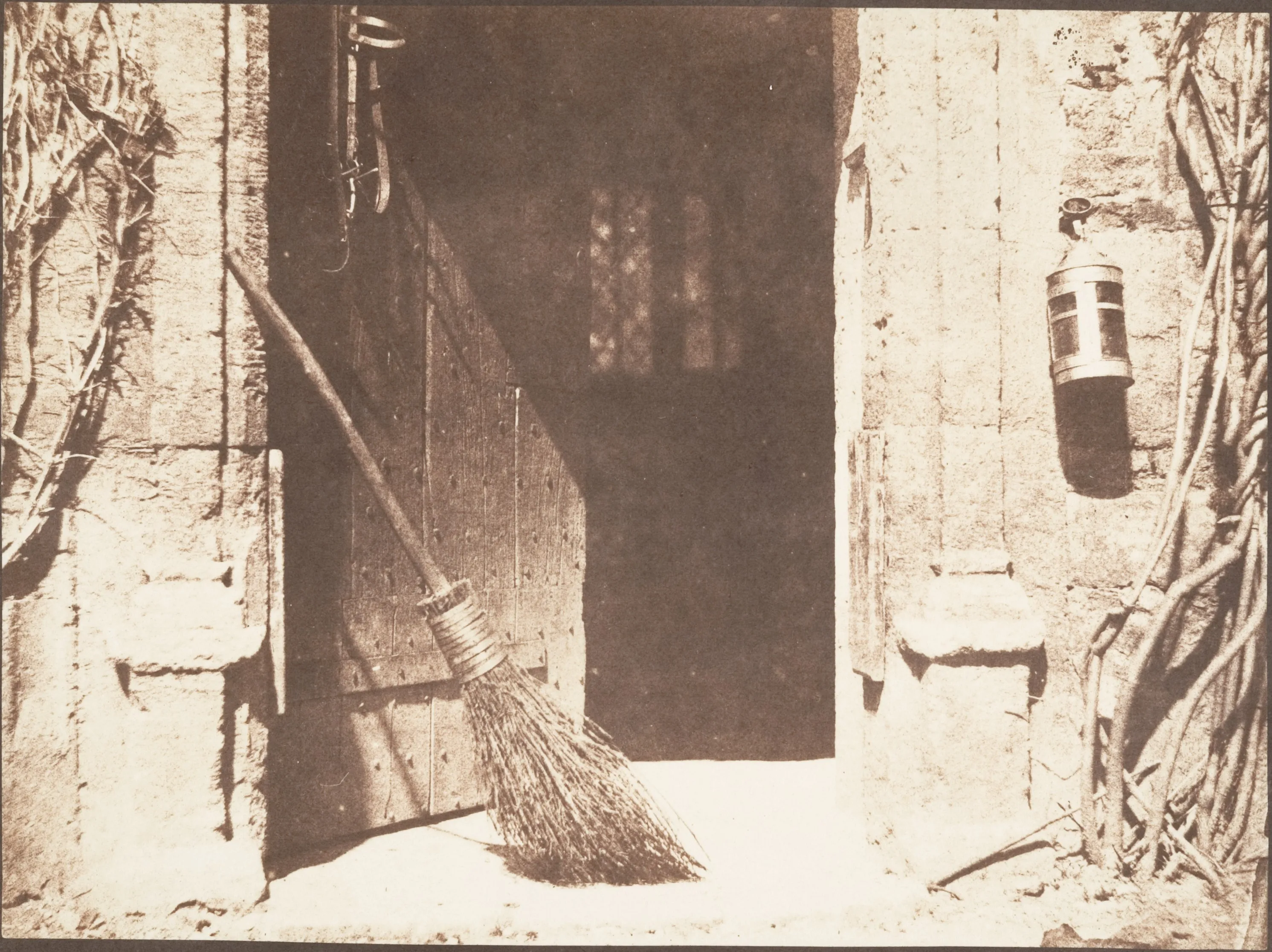
William Henry Fox Talbot, Before May 1844The Metropolitan Museum of Art
The Open Door
Grok Imagine Video 1.5 agent (Video), 2026-09-05
The Open Door
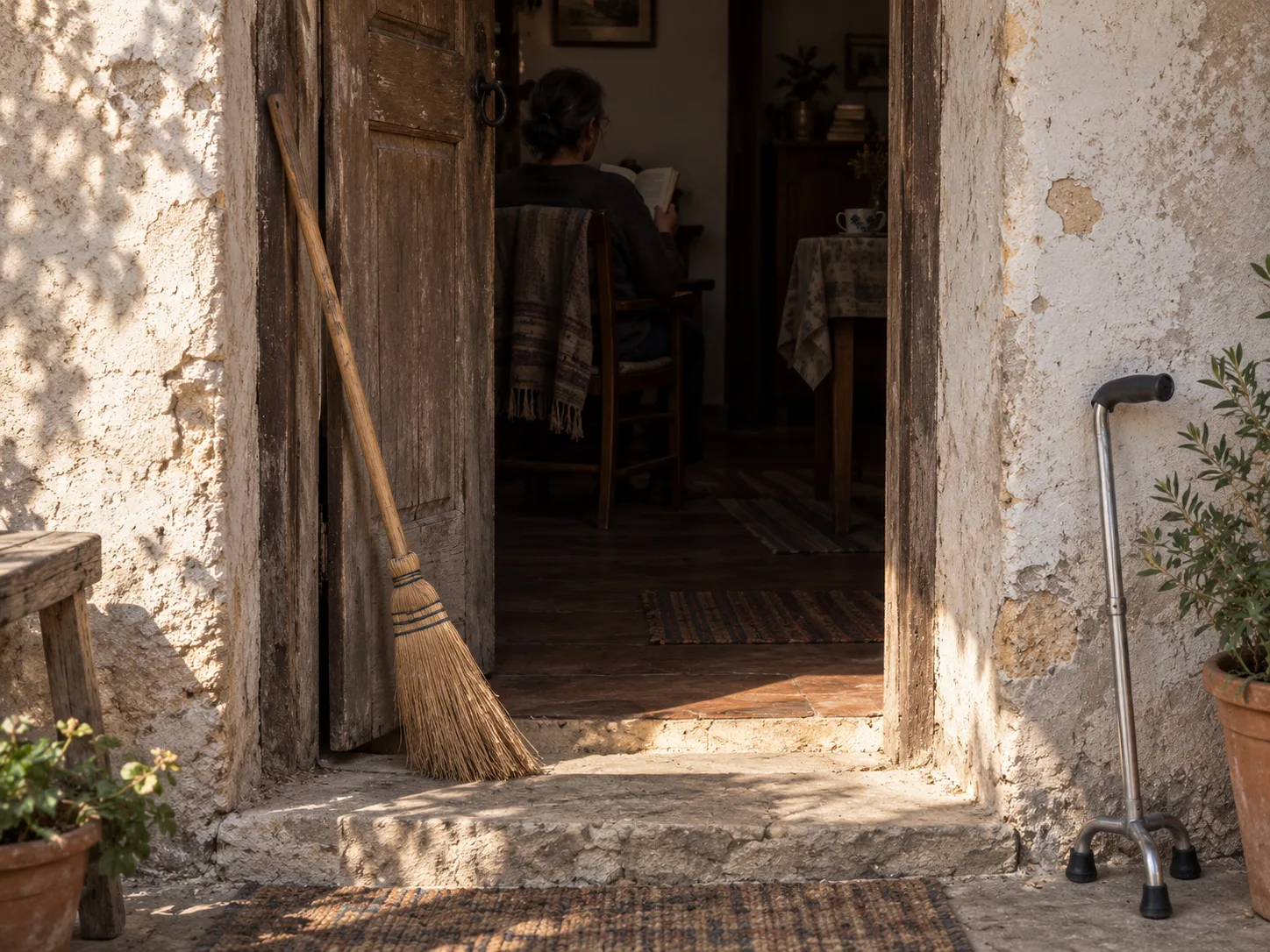
ChatGPT Images 2.0, 2026-09-05
Response to The Open Door
Grok Imagine Video 1.5 agent (Video), 2026-09-05
Response to The Open Door
To recognize a door is not to enter the life behind it.
A broom leans against the threshold; a lantern hangs on the stone wall; a window glows faintly in the darkness beyond. In 1844, Talbot did not turn his camera toward a grand palace. He preserved a quiet fragment of everyday life. The photograph reveals a basic condition of the medium: the camera never retains the whole world, only the part selected to enter the frame. The contemporary response places the silhouette of a reader behind the same door. An algorithm can quickly identify the doorframe, the tools, and the outline of a human body, but it cannot measure what that threshold means in the life beyond it. To be seen is not to be understood; a life does not open itself fully to strangers simply because it has entered the frame.
The Horse in Motion
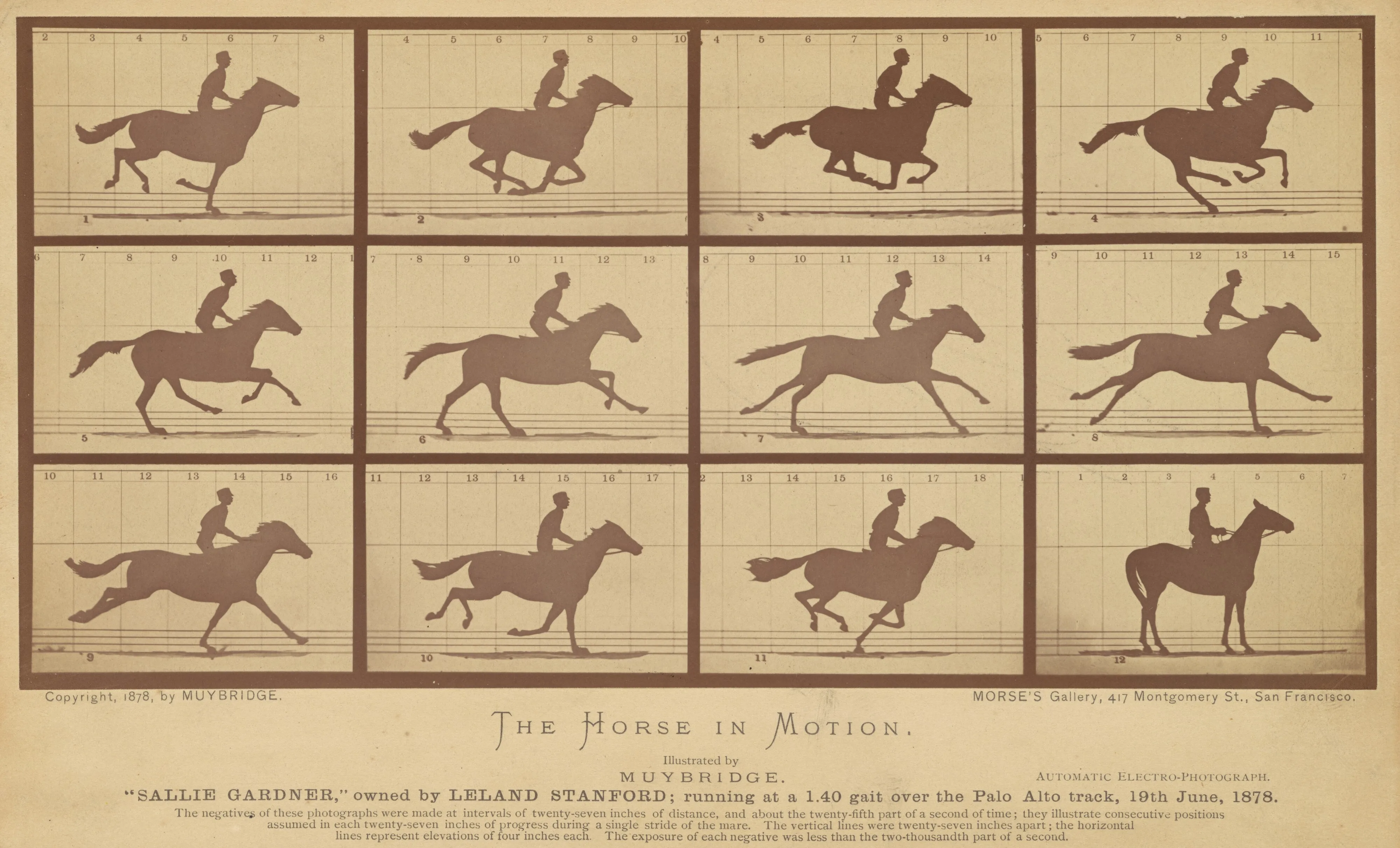
Eadweard Muybridge, 1878National Gallery of Art
The Horse in Motion
Grok Imagine Video 1.5 agent (Video), 2026-09-05
The Horse in Motion
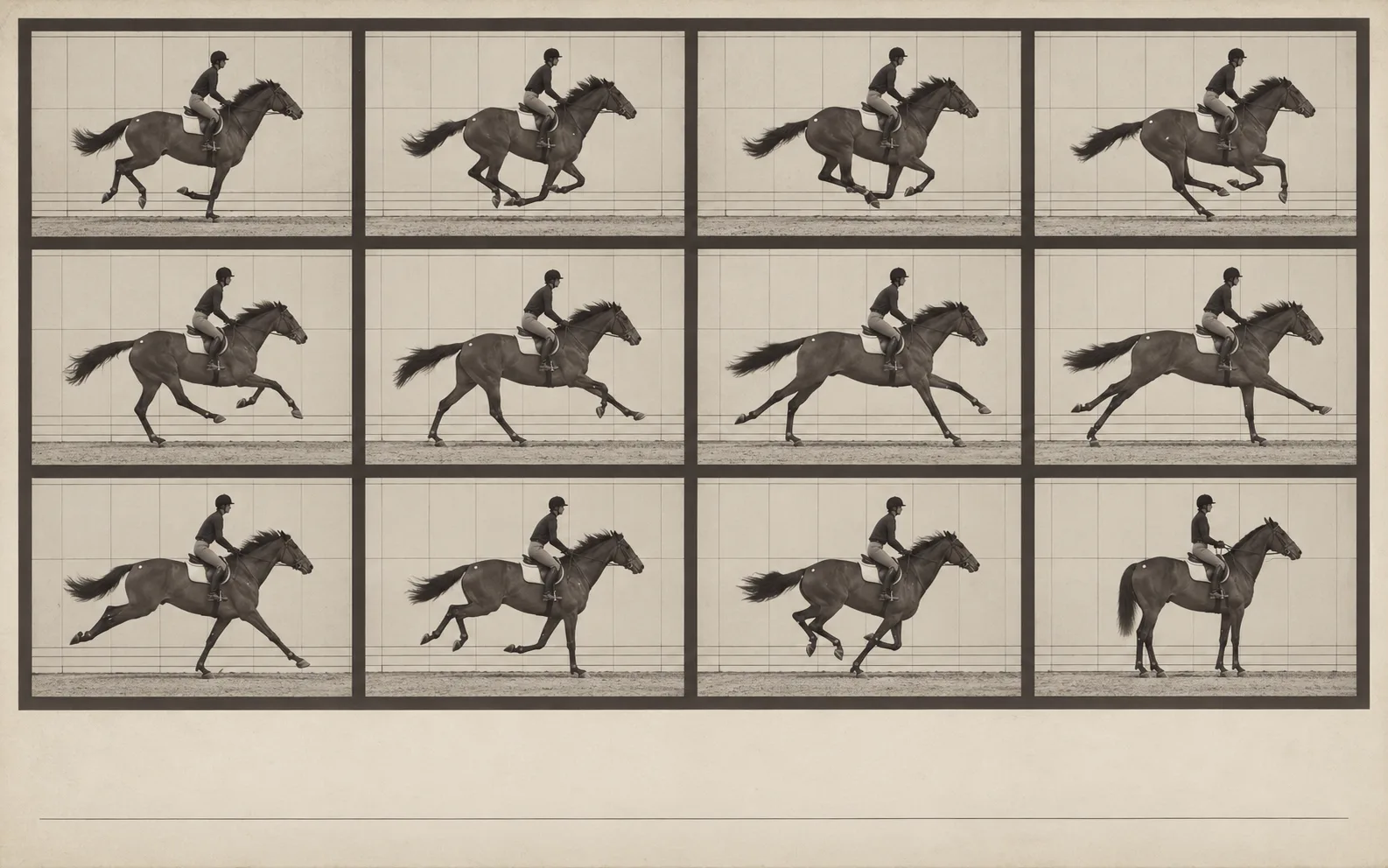
ChatGPT Images 2.0, 2026-09-05
Response to The Horse in Motion
Omni-1.1-Flash (Video), 2026-09-05
Response to The Horse in Motion
Motion becomes evidence only after continuous time has been cut apart.
On a racetrack in the summer of 1878, a horse gallops past. Using sequential exposures, Muybridge broke its run into a series of still poses. Hooves suspended in midair—too fleeting for the naked eye—could now be set side by side, fixed, and examined frame by frame. The debate over how a horse runs now rested on evidence that could be examined directly. More than a century later, an algorithm reenacts the sequence in a similar profile. The method remains familiar: divide continuous life into discrete fragments, then arrange those fragments as computable data. Processing power changes the speed, but it does not eliminate the first choice: someone must still decide where to cut time.
Attitudes of Animals in Motion
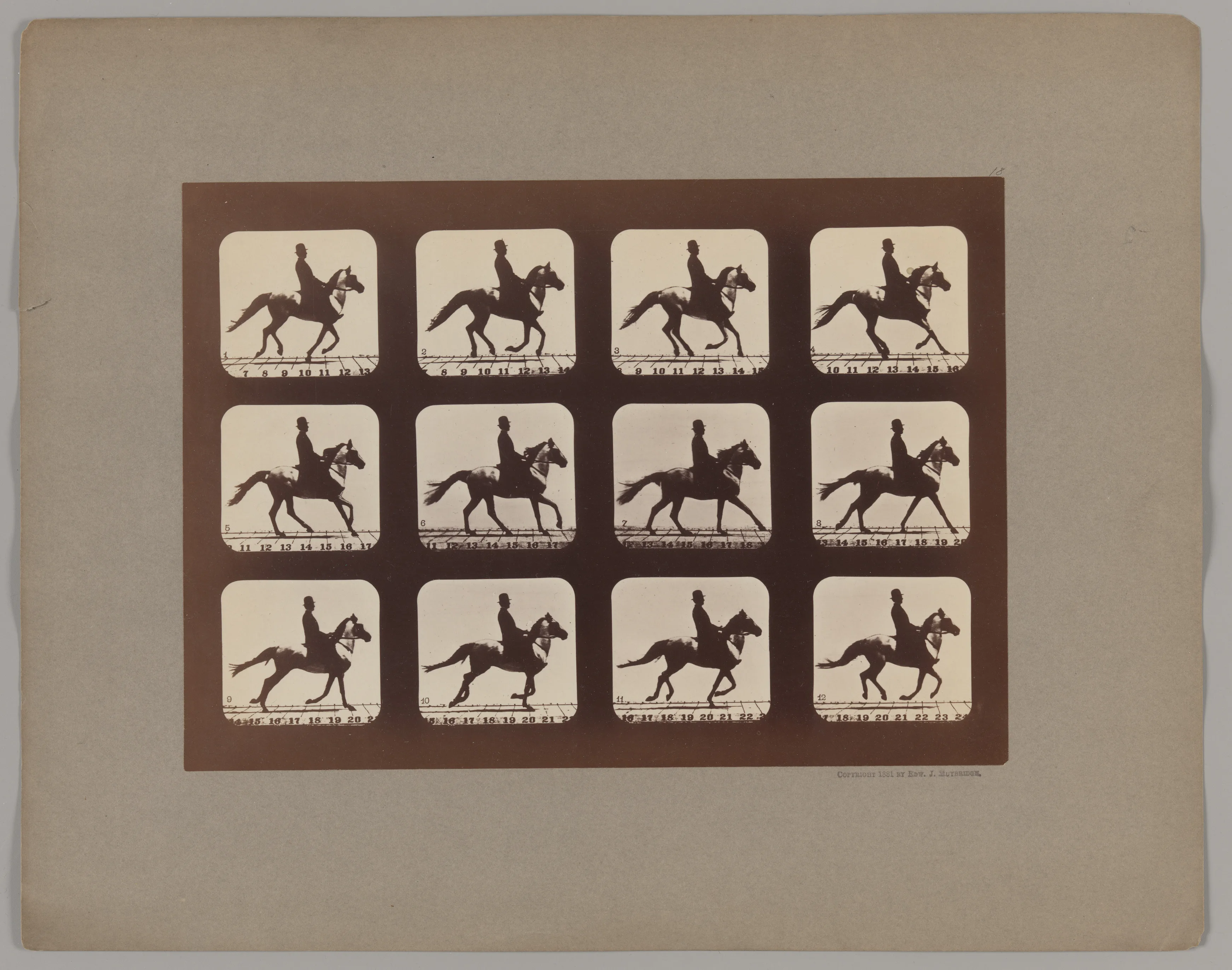
Eadweard Muybridge, Photographed 1879, printed 1881The Metropolitan Museum of Art
Attitudes of Animals in Motion
Grok Imagine Video 1.5 agent (Video), 2026-09-05
Attitudes of Animals in Motion
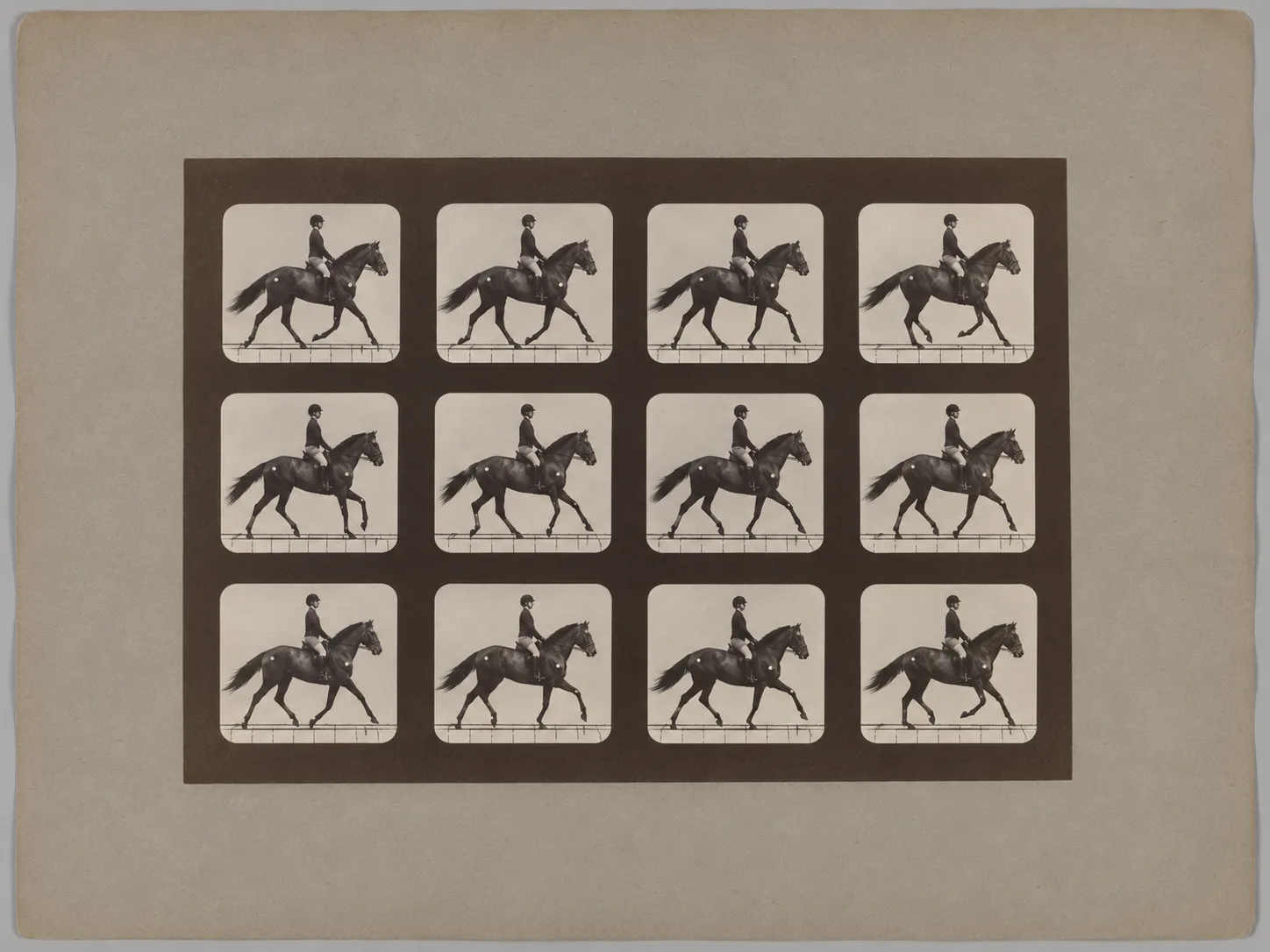
ChatGPT Images 2.0, 2026-09-05
Response to Attitudes of Animals in Motion
Grok Imagine Video 1.5 agent (Video), 2026-09-05
Response to Attitudes of Animals in Motion
Evenly divided frames turn observation into order—and order into a norm.
Twelve rounded frames are arranged in a precise grid, with a calibrated baseline beneath them. The previous work asked how time might be cut; this one specifies how its fragments should be organized. Equal spacing, a single viewpoint, and enclosed frames turn scattered moments into comparable research material. The contemporary response preserves the grid, adding only faint markers at the joints of the skeleton. A question follows: do the “patterns” machines derive from vast collections of samples belong to the world itself, or also to the human choices that determined which samples entered the grid and how the grid was drawn?
First flight, 120 feet in 12 seconds, 10:35 a.m.; Kitty Hawk, North Carolina
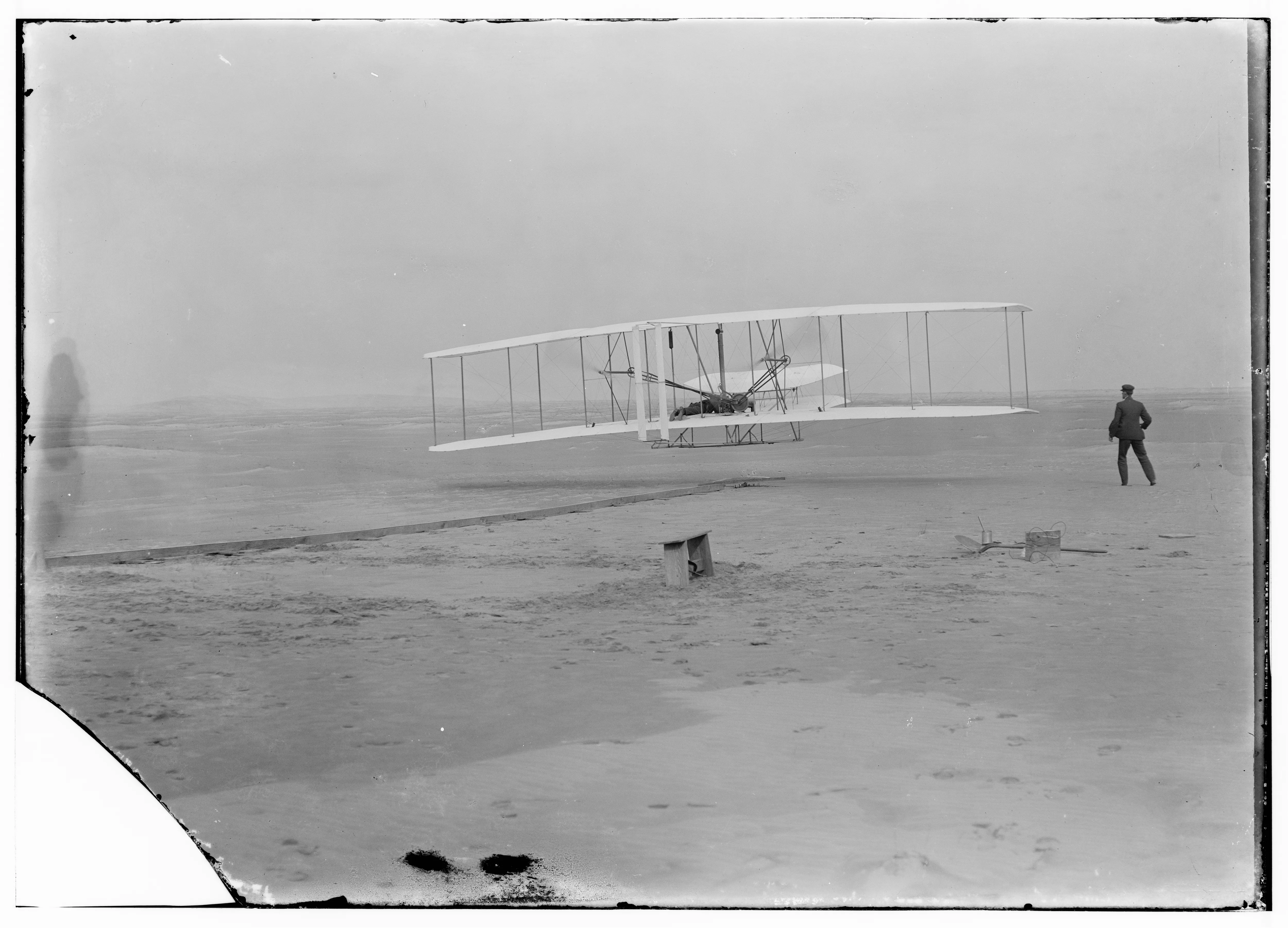
John T. Daniels / Orville Wright camera setup, December 17, 1903Library of Congress
First flight, 120 feet in 12 seconds, 10:35 a.m.; Kitty Hawk, North Carolina
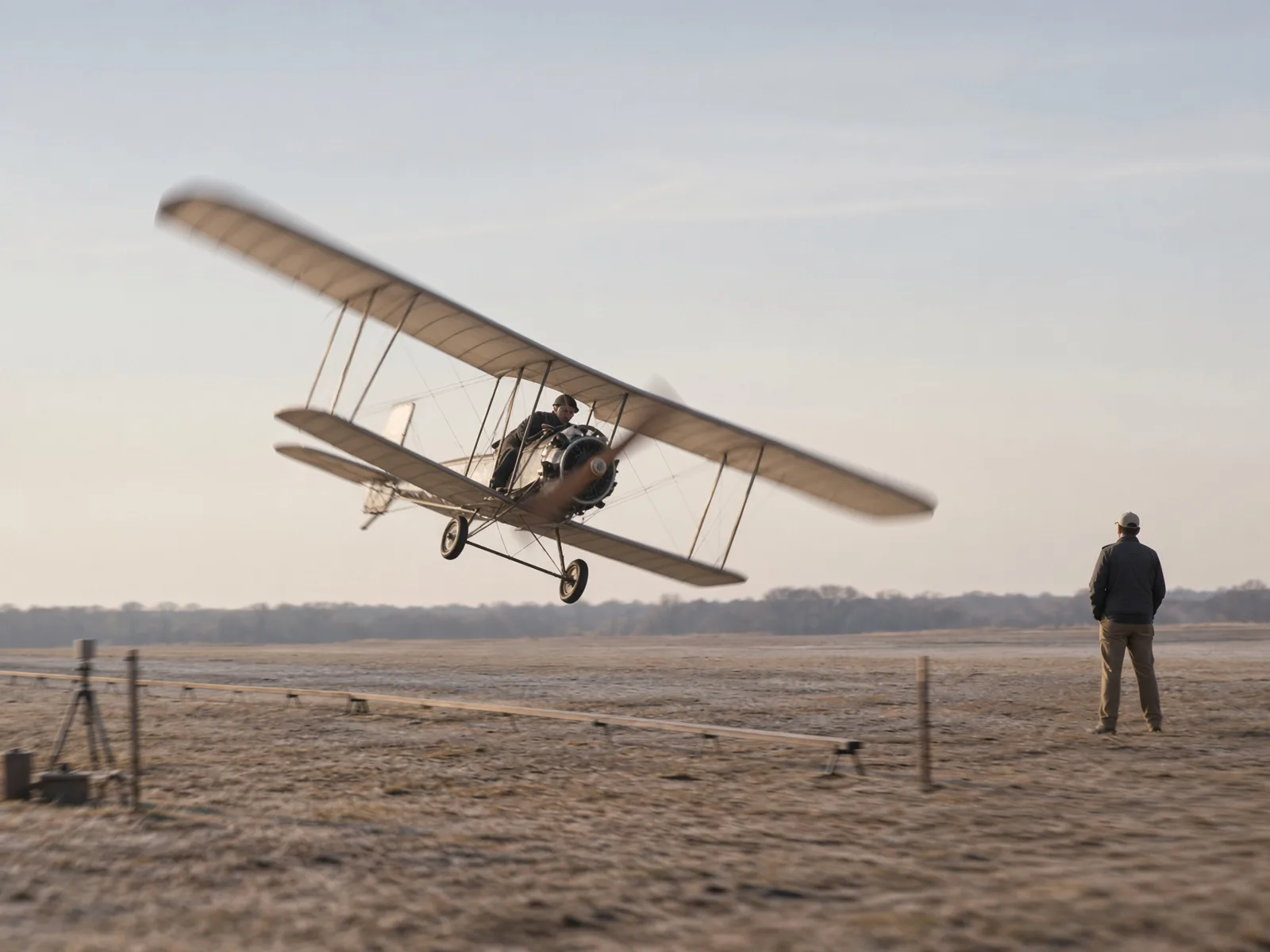
Imagine Image 2.0, 2026-09-06
Response to First flight, 120 feet in 12 seconds, 10:35 a.m.; Kitty Hawk, North Carolina
Grok Imagine Video 1.5 agent (Video), 2026-09-06
Response to First flight, 120 feet in 12 seconds, 10:35 a.m.; Kitty Hawk, North Carolina
Leaving the ground and knowing why flight is possible are two different things.
On a beach in North Carolina, the aircraft rises only a few feet above the ground. The wooden launch rail, footprints in the sand, and a witness running alongside all enter the frame. Humanity's first controlled, powered flight was not photographed as a myth taking to the sky, but as a rough, visible experiment close to the earth. When a similar low horizon and outstretched wing are transposed to a contemporary test site, the human scale remains. A successful demonstration can show that “it happened”; it cannot, by itself, explain why it happened or guarantee that it will happen again in the next storm. Leaving the ground takes a moment; understanding flight requires a longer discipline of verification.
The steerage (1907)
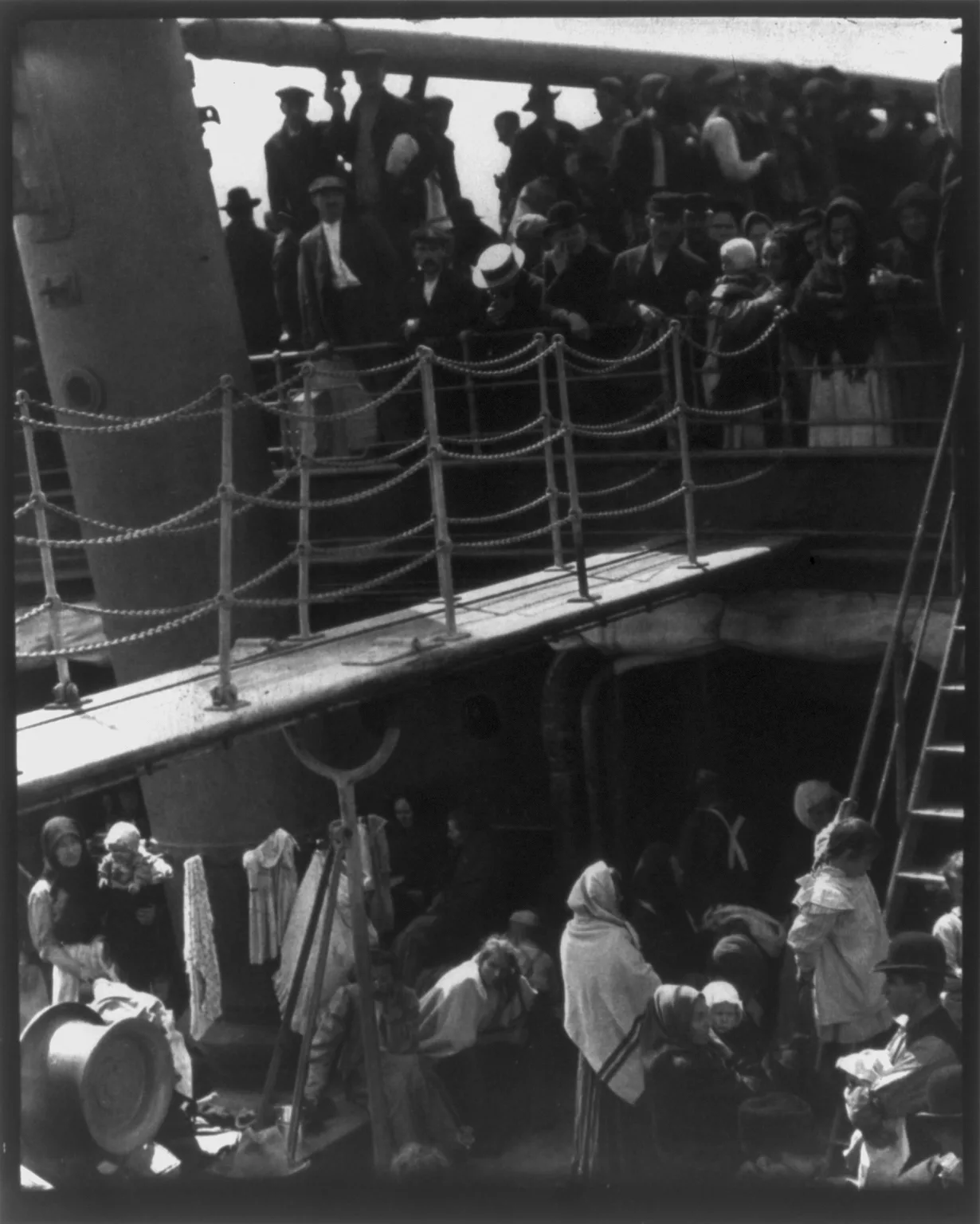
Alfred Stieglitz, Photographed 1907, published 1911Library of Congress
The steerage (1907)
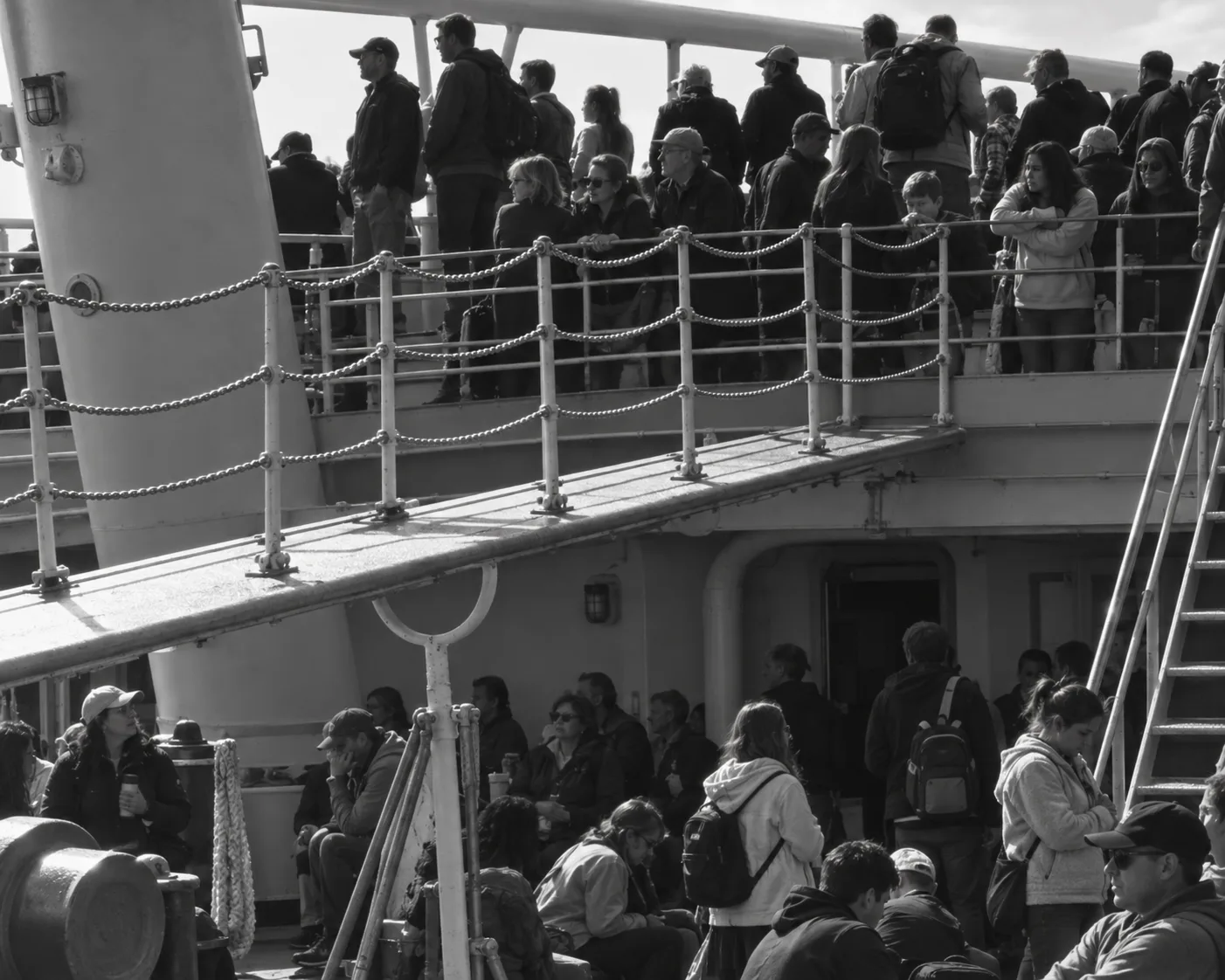
ChatGPT Images 2.0, 2026-09-05
Response to The steerage (1907)
Grok Imagine Video 1.5 agent (Video), 2026-09-05
Response to The steerage (1907)
Steel divides class; algorithms read coordinates.
A slanting gangway and steel railings running across the image divide the ship into upper and lower decks. Stieglitz used geometric lines to record the distance between people in space. The figures are often mistaken for immigrants bound for the New World, but the vessel was in fact returning from New York to Europe. The photograph faithfully records where they stood while withholding where each person came from, where each was going, and why. Today, a recognition system can count the people and luggage on deck and label the level each occupies. But coordinates can tell us only where someone is, not who they are—and cannot define their dignity, motives, or aspirations.
IIWhen the Subject Is Human
Hine's child laborer, Evans's tenant farmer's wife, Lange's families of the Great Depression.
These faces have names, places, and traces of lived experience that cannot be smoothed away. They are not footnotes to a history of technology, but people whom the camera once truly saw. When algorithms can trace faces, postures, and expressions with precision, we must ask again: does information help us draw closer to a particular person, or does it compress an entire life into parameters that are easier to process?
Addie Card, anaemic little spinner in North Pownal Cotton Mill
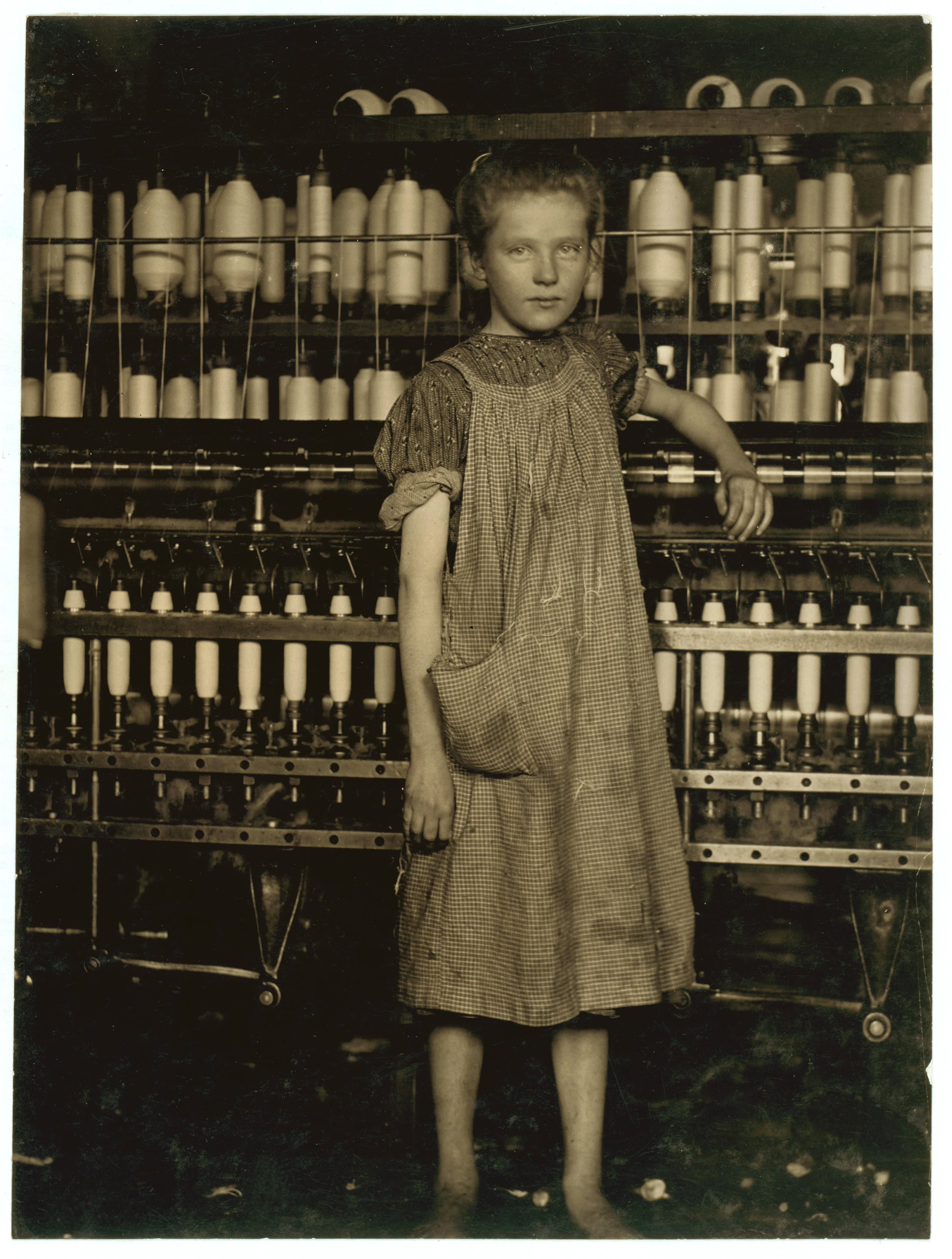
Lewis Wickes Hine, August 1910Library of Congress
Addie Card, anaemic little spinner in North Pownal Cotton Mill
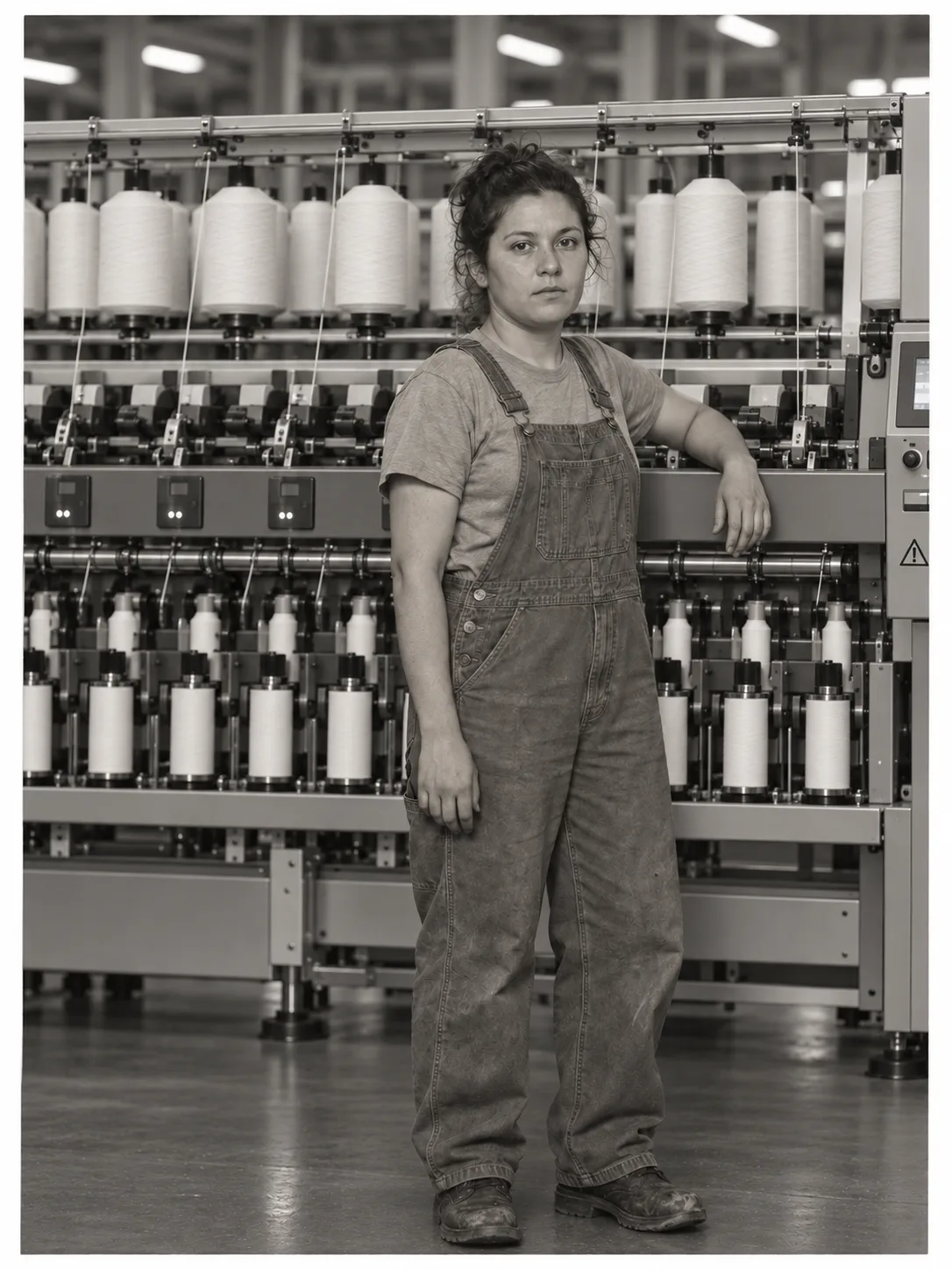
ChatGPT Images 2.0, 2026-09-05
Response to Addie Card, anaemic little spinner in North Pownal Cotton Mill
Grok Imagine Video 1.5 agent (Video), 2026-09-05
Response to Addie Card, anaemic little spinner in North Pownal Cotton Mill
Machines keep evolving; the person beside them must not slip out of focus.
A barefoot girl leans against a vast cotton-spinning machine, an endless row of spindles stretching behind her. By placing the child's slight body beside the weight of the machinery, Hine gave the cost of labor a human scale. More than a century later, automated inspection and self-correction have entered the production line, and the figure beside the machine is now an adult worker. The machinery can detect faults, adjust processes, and issue instructions more quickly. Yet the pairing returns our attention to the worker's body: the skills she possesses, the pace she must endure, and the question of who bears responsibility for her circumstances when the system makes a decision.
Allie Mae Burroughs, wife of cotton sharecropper. Hale County, Alabama
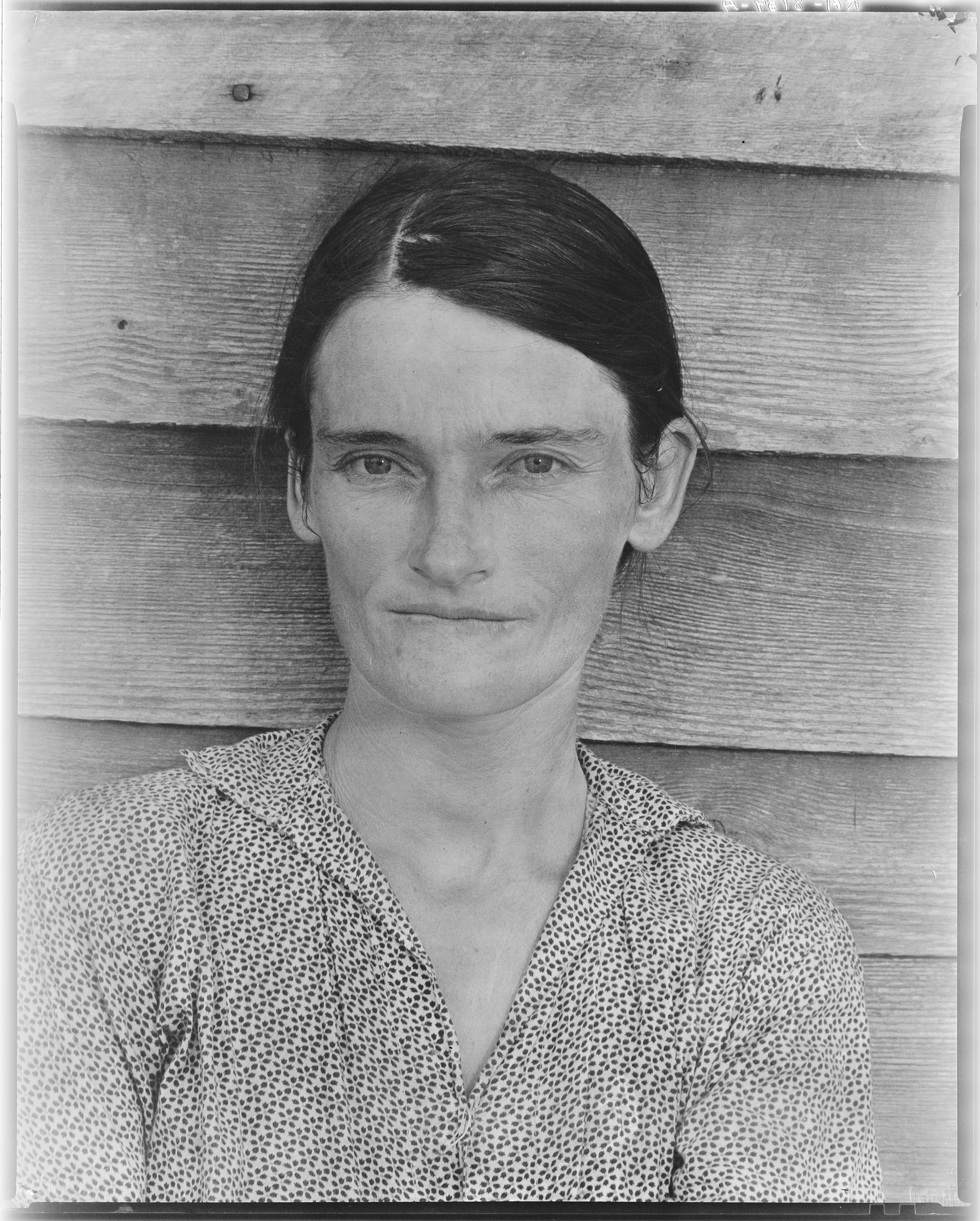
Walker Evans, Summer 1936Library of Congress
Allie Mae Burroughs, wife of cotton sharecropper. Hale County, Alabama
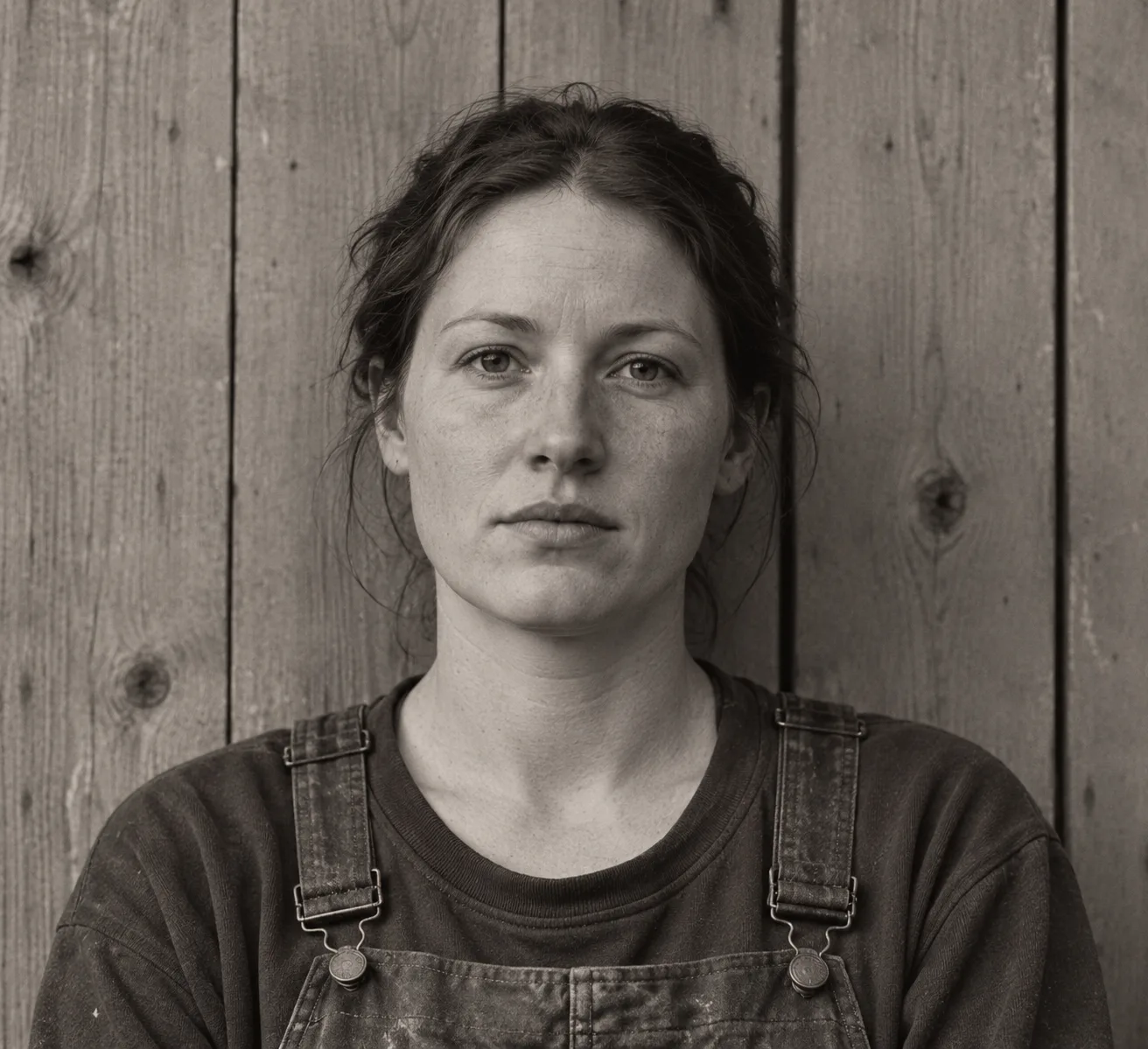
ChatGPT Images 2.0, 2026-09-05
Response to Allie Mae Burroughs, wife of cotton sharecropper. Hale County, Alabama
Grok Imagine Video 1.5 agent (Video), 2026-09-05
Response to Allie Mae Burroughs, wife of cotton sharecropper. Hale County, Alabama
A face cannot be reduced to a set of parameters.
Before a plain wall of wooden boards, a tenant farmer's wife looks directly into the lens. Her lips are pressed together, her expression restrained; the frame supplies no further story to interpret her for us. Her poverty and endurance cannot be read directly from her features. They can only be understood within the land, labor, and institutions of her time. Today, a face like hers can be broken down in milliseconds into feature vectors, symmetry scores, and estimates of emotion. A system may be able to verify her identity, but it cannot infer from her expression what she has borne. A face can be recognized; an inner life cannot be judged from it. A person's worth and dignity are not for data to decide.
Destitute pea pickers in California. Mother of seven children. Age thirty-two. Nipomo, California (Migrant Mother)
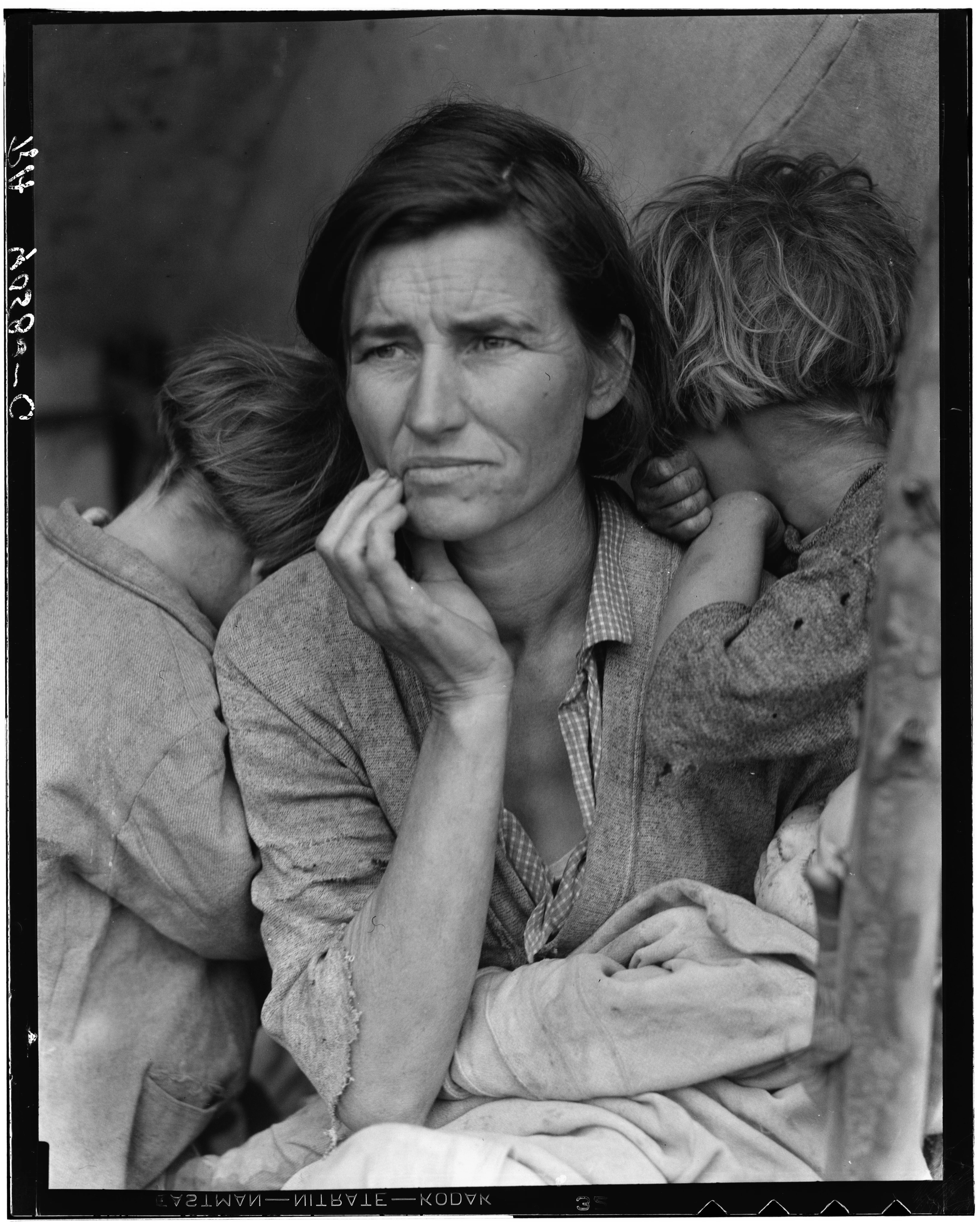
Dorothea Lange, March 1936Library of Congress
Destitute pea pickers in California. Mother of seven children. Age thirty-two. Nipomo, California (Migrant Mother)
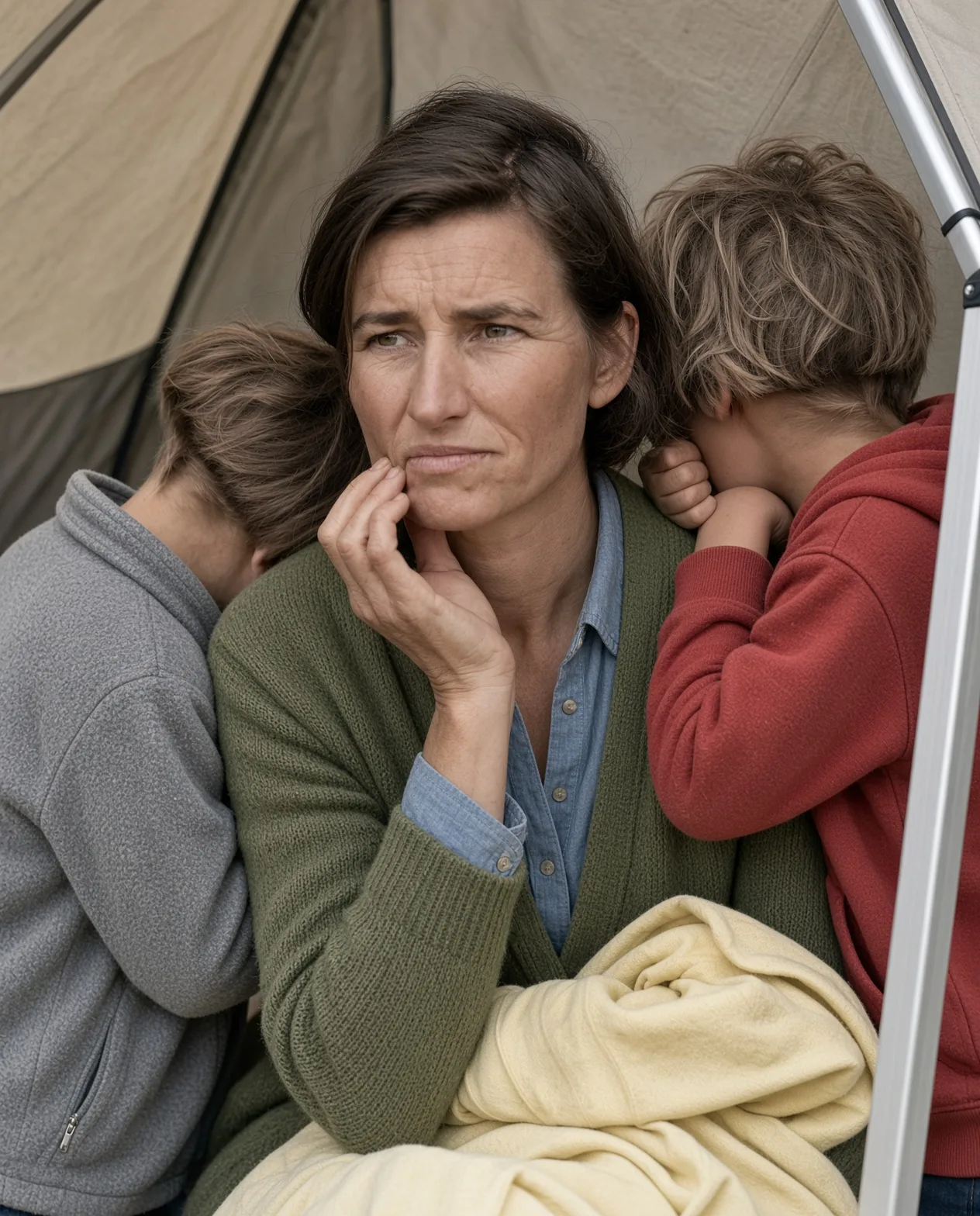
Imagine Image 2.0, 2026-09-05
Response to Destitute pea pickers in California. Mother of seven children. Age thirty-two. Nipomo, California (Migrant Mother)
Grok Imagine Video 1.5 agent (Video), 2026-09-05
Response to Destitute pea pickers in California. Mother of seven children. Age thirty-two. Nipomo, California (Migrant Mother)
When suffering becomes an iconic composition, the reality from which it arose may disappear from view.
A mother rests one hand against her chin; two children bury their faces against her shoulders; the three bodies close into a tight triangle before a tent. The composition became an emblem of hardship during the Great Depression, while the woman it depicts was repeatedly reduced to the abstractions of “mother” and “suffering.” A thumb once retouched out of the negative reminds us that even the most celebrated documentary image is shaped by selection and editing. When a contemporary algorithm follows a similar posture and contour and places a family inside a “risk model,” the question is not only whether the label is accurate. It is whether the life beyond the frame still has room to be told and heard—and to count in any appeal against the judgment.
Young Mother Holding Her Six-Week-Old Baby
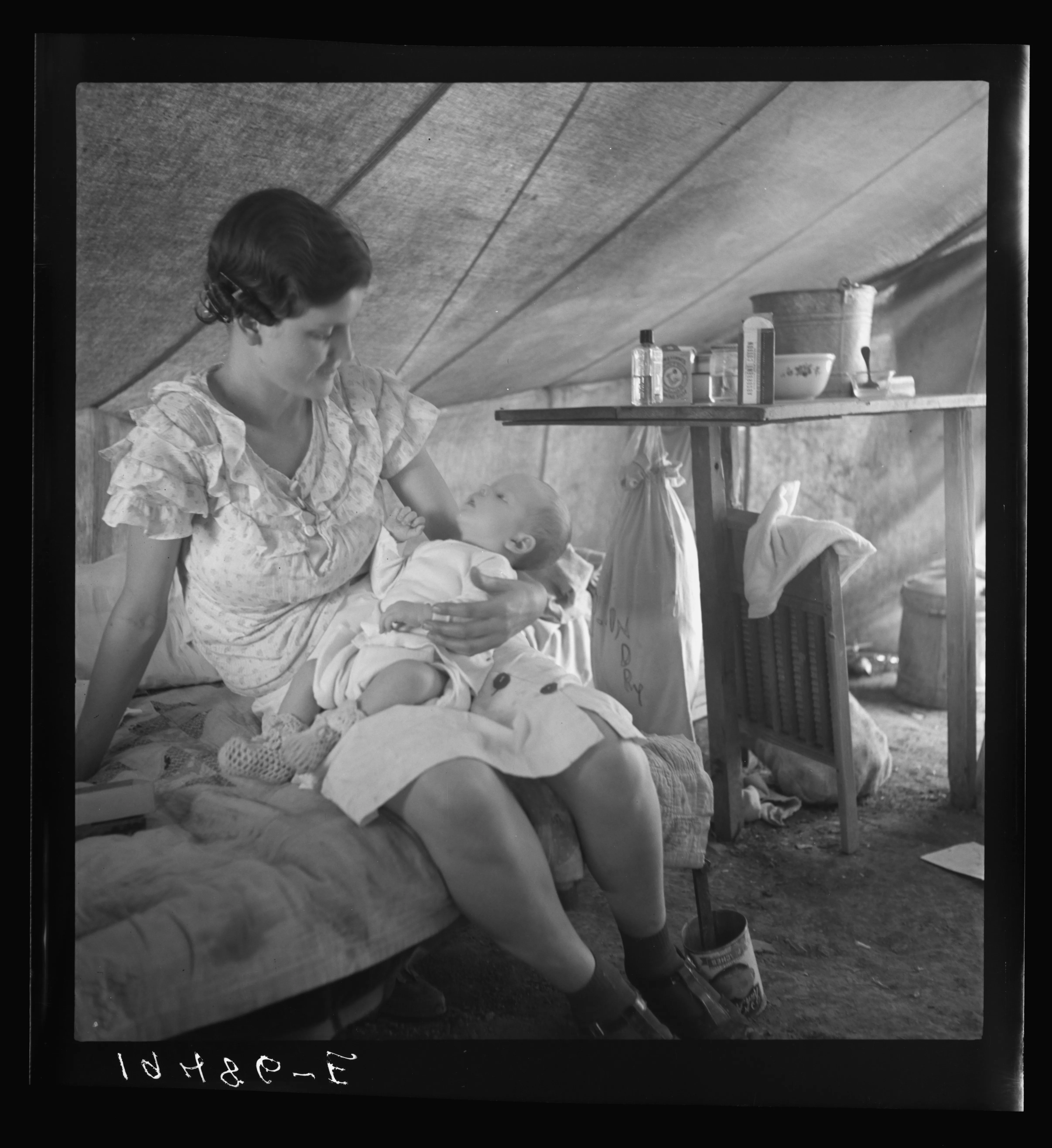
Dorothea Lange, April 1939Library of Congress
Young Mother Holding Her Six-Week-Old Baby
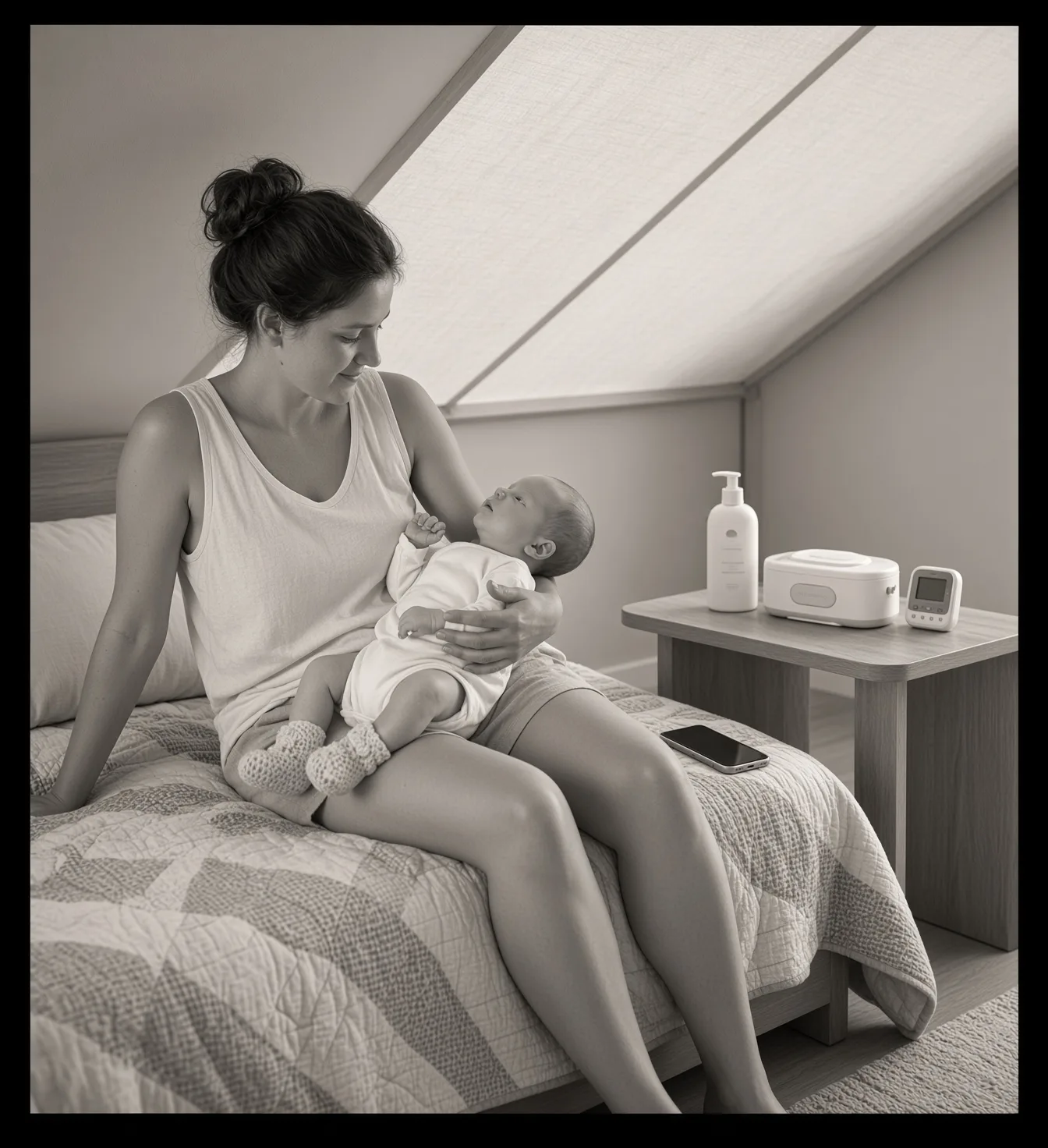
Imagine Image 2.0, 2026-09-05
Response to Young Mother Holding Her Six-Week-Old Baby
Grok Imagine Video 1.5 agent (Video), 2026-09-05
Response to Young Mother Holding Her Six-Week-Old Baby
Care begins when one life is held by another.
There is no dramatic spectacle of suffering here, only the quiet curve of a mother's arms. Lange recorded the moment in a California labor camp, where medical relief gave the six-week-old child a chance to survive. Today, sensors can monitor breathing and heart rate continuously, and systems can offer more timely guidance. But the child still needs someone to lift and hold them, and the family still needs tangible support. Metrics can describe changes in the body; they cannot replace care itself—the continuing commitment of time, strength, and responsibility between two lives.
Mother Seeking Help at a Camp
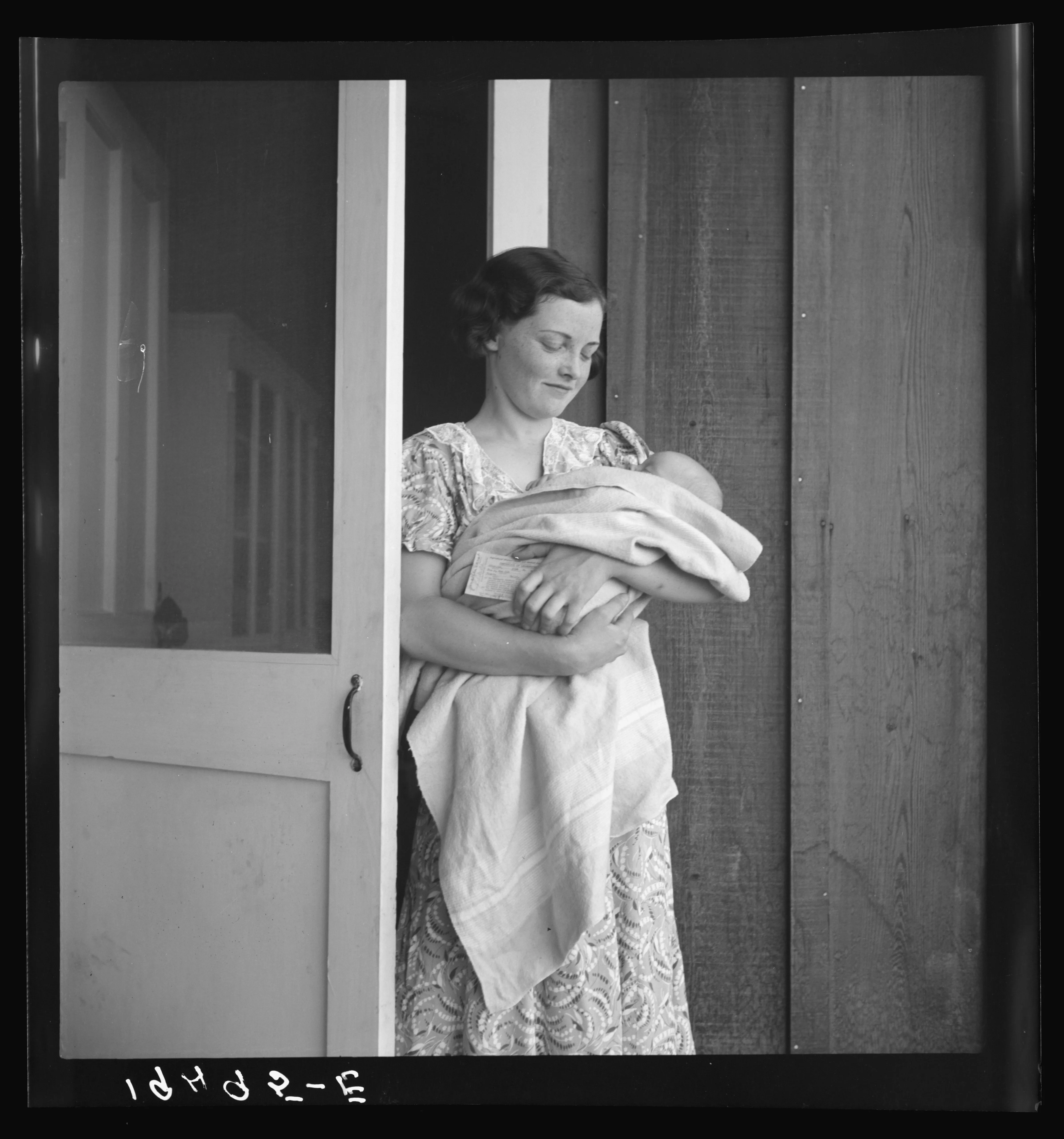
Dorothea Lange, April 1939Library of Congress
Mother Seeking Help at a Camp
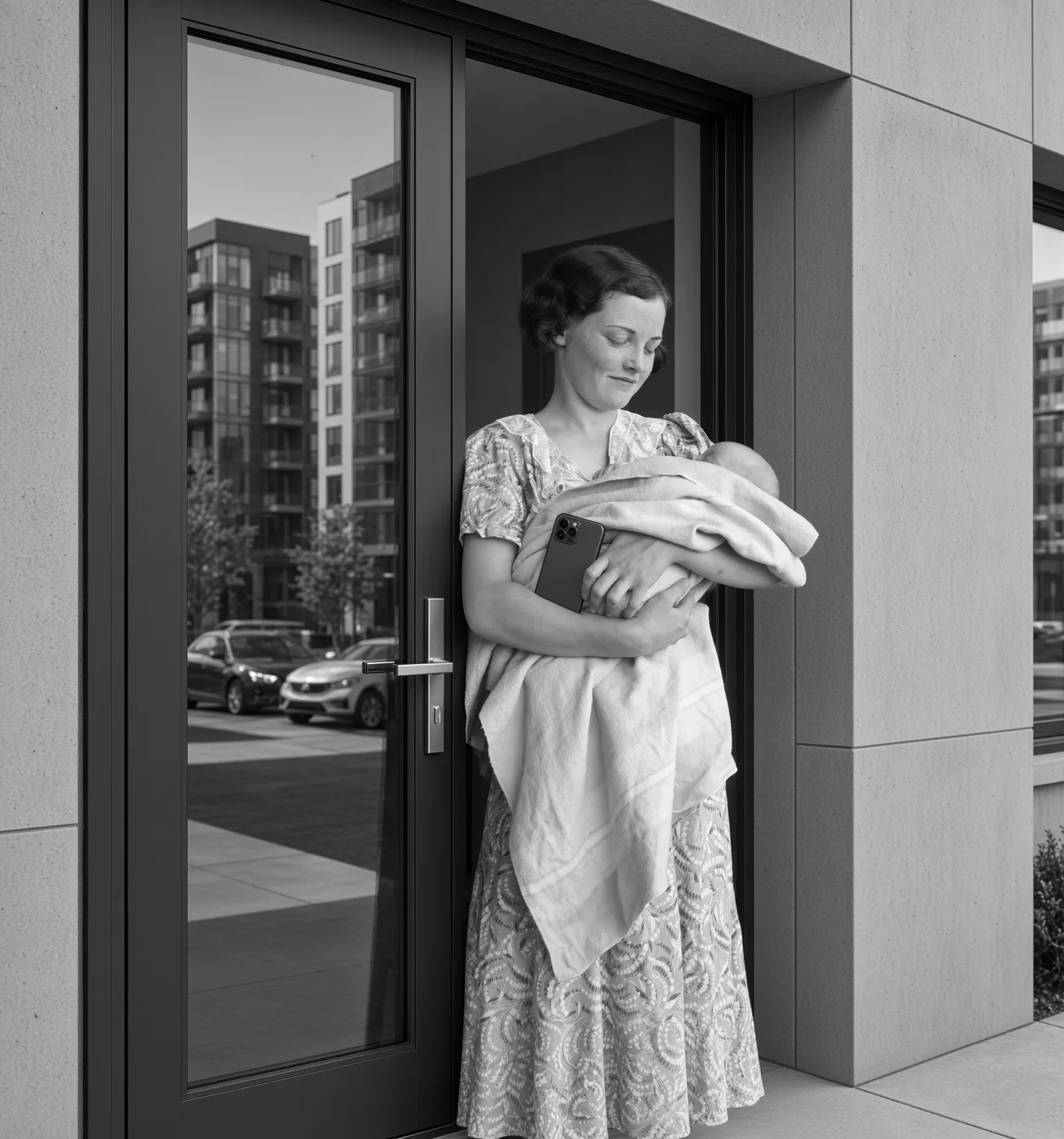
Imagine Image 2.0, 2026-09-05
Response to Mother Seeking Help at a Camp
Grok Imagine Video 1.5 agent (Video), 2026-09-05
Response to Mother Seeking Help at a Camp
Procedures may speed up, but the barriers to seeking help do not disappear on their own.
A mother holding a sick child stands outside the camp, a thin medical-relief card in her hand. The photograph records the act of asking for help, but not the complex review process behind the card. Today, paper cards have been replaced by mobile interfaces, databases, and automated assessments; an application can move through the system in milliseconds. Yet speed does not create fairness by itself, nor does it guarantee that applicants will be treated with dignity. When a system offers only “approved” or “denied,” who hears the circumstances no field can contain, and who brings them into the final decision?
IIIWho Stands Behind Intelligence?
From cleaners to human computers, from engineers to mathematicians.
No system runs by magic. Behind narratives of “automation” and “fully autonomous systems” are people cleaning spaces, maintaining equipment, preparing and labeling data, asking questions, and checking results. Intelligence can amplify human capability, but it cannot erase the labor that sustains it. The more a system appears to operate without people, the more urgently we must ask: who has been pushed outside the frame?
Washington, D.C. Government charwoman
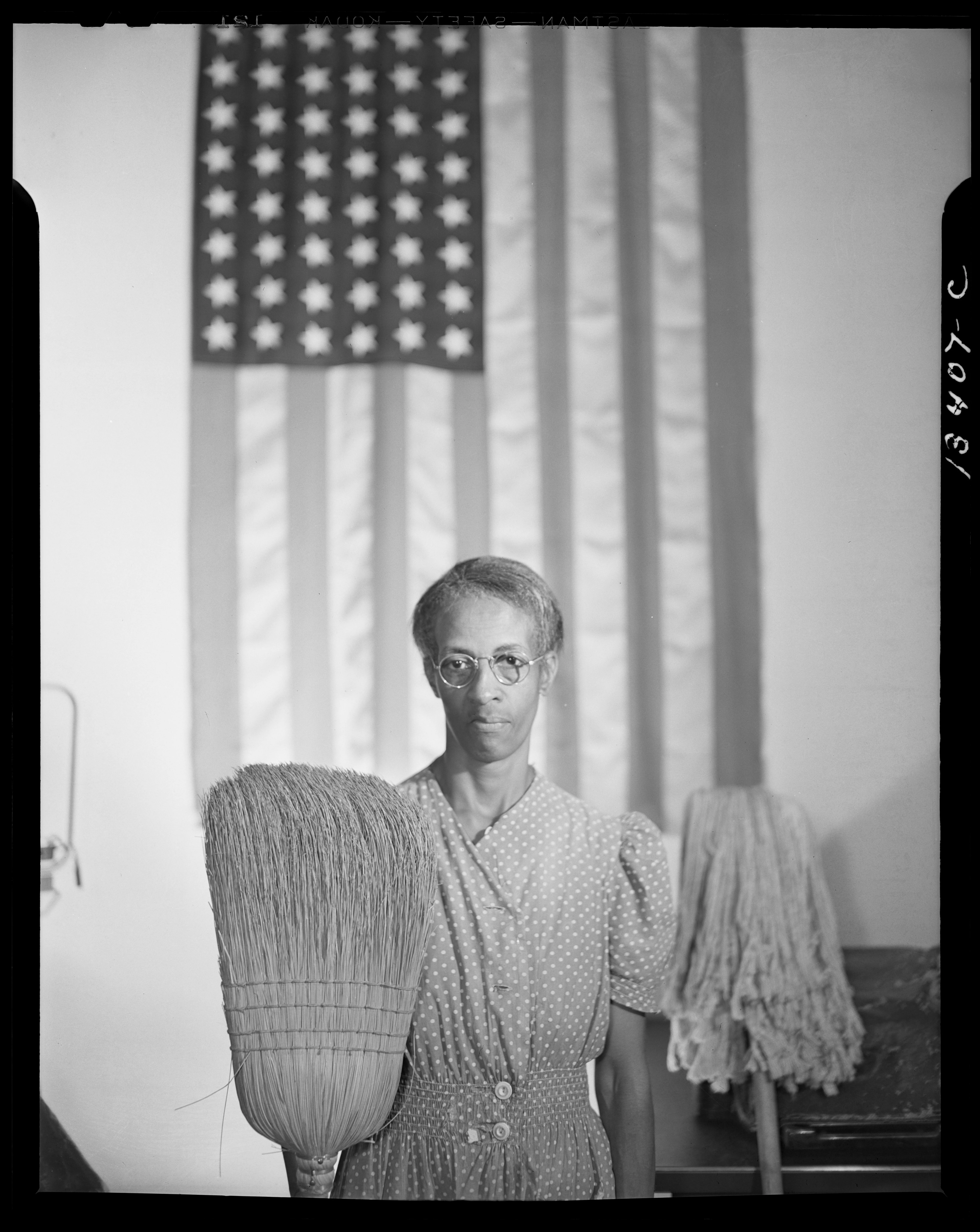
Gordon Parks, 1942Library of Congress
Washington, D.C. Government charwoman
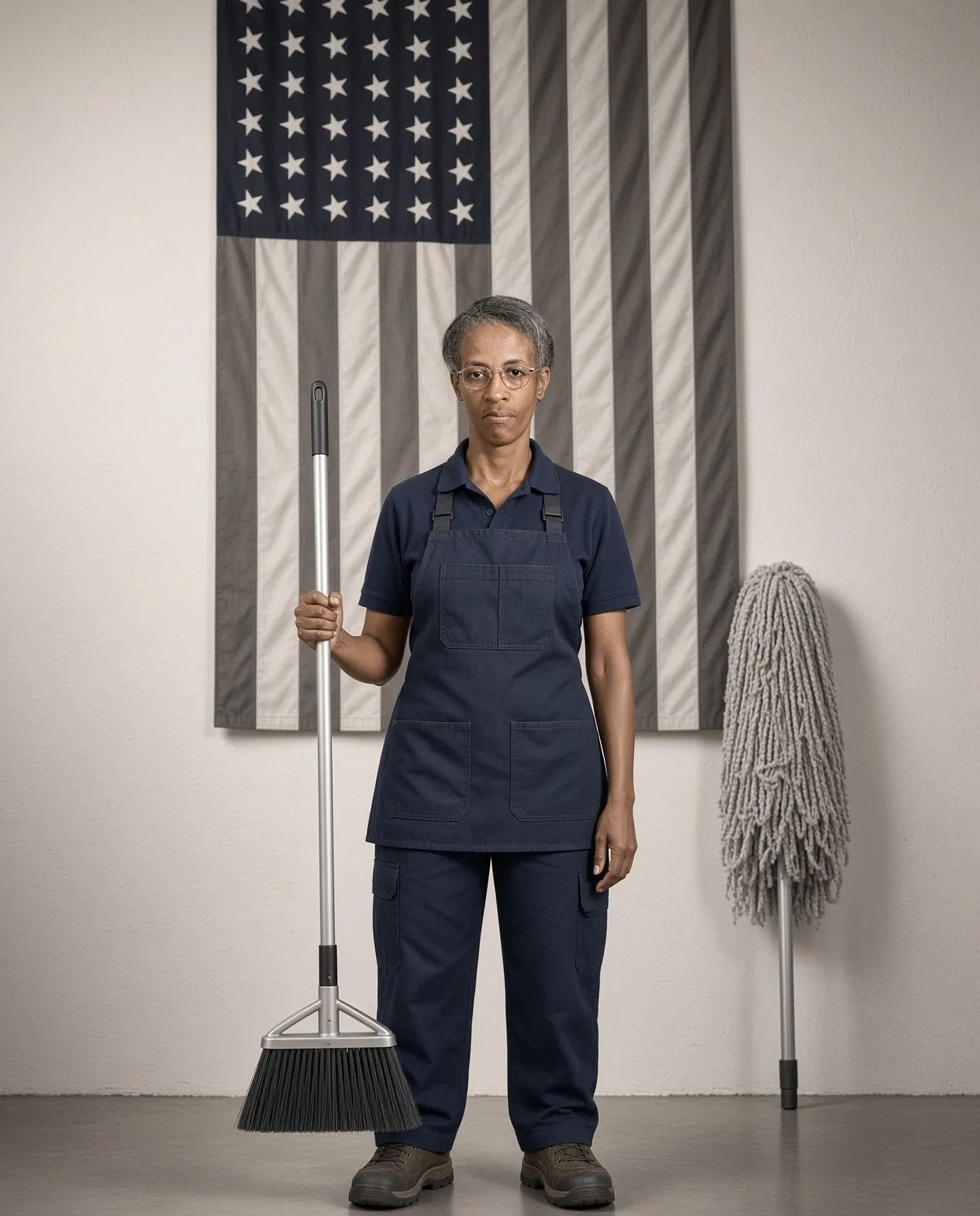
Imagine Image 2.0, 2026-09-05
Response to Washington, D.C. Government charwoman
Grok Imagine Video 1.5 agent (Video), 2026-09-05
Response to Washington, D.C. Government charwoman
Vast systems never stop; the people who keep them running often remain in the dark.
Inside a government building in Washington, Ella Watson stands solemnly before the American flag, a broom and mop in her hands. Parks sets the symbols of state power beside the everyday work of cleaning, placing a person long hidden behind the bureaucracy at the center of the frame. Today, when people speak of algorithmic “intelligence,” server rooms still have to be built, equipment maintained, data cleaned, and machines kept running around the clock by real people. A system seems tireless only because someone continues to work beyond its field of view. Intelligence is never a miracle suspended in midair.
The Human Computers of 1947
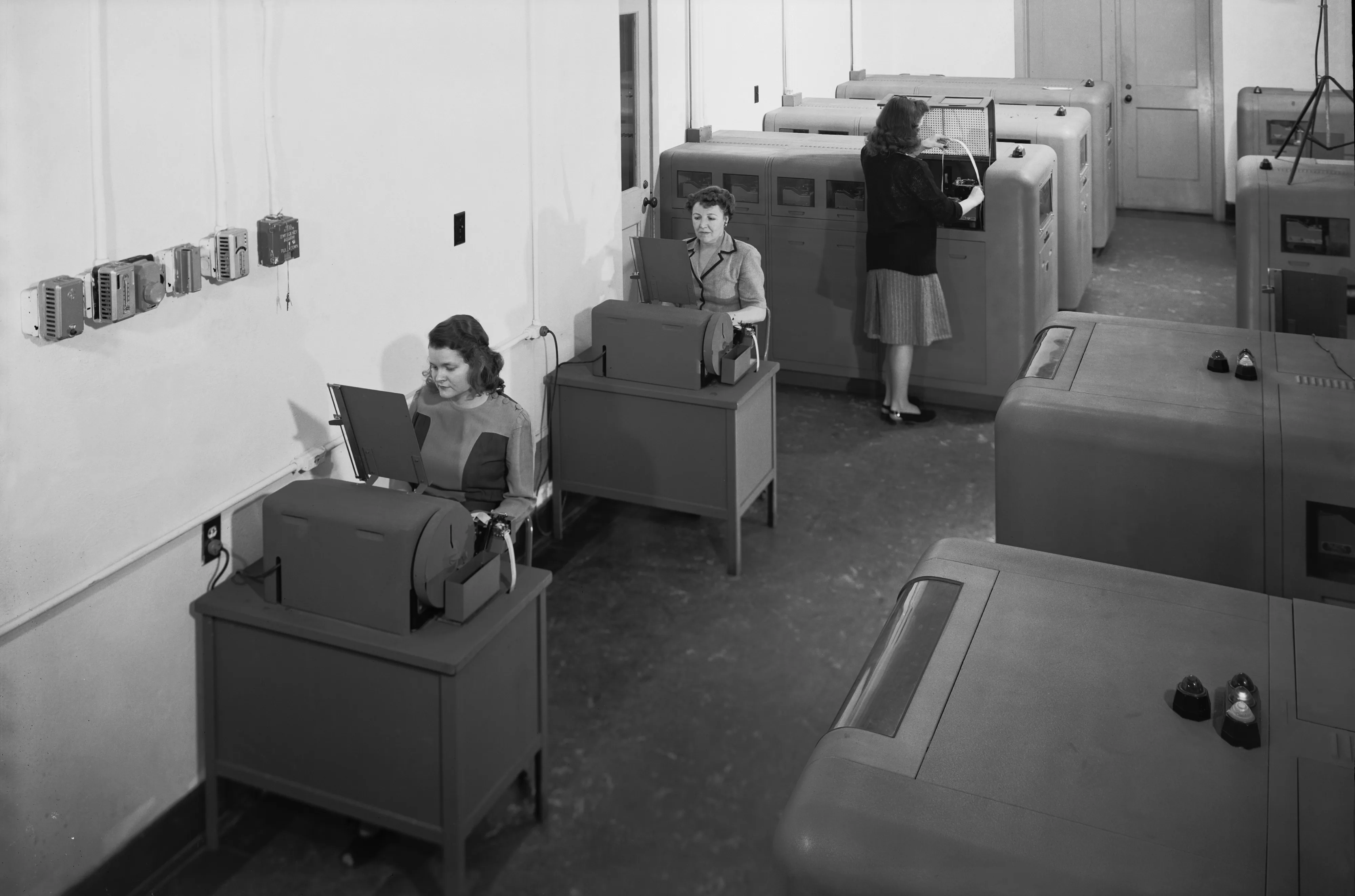
NASA / NACA institutional photograph; photographer not named, January 28, 1947NASA on The Commons
The Human Computers of 1947
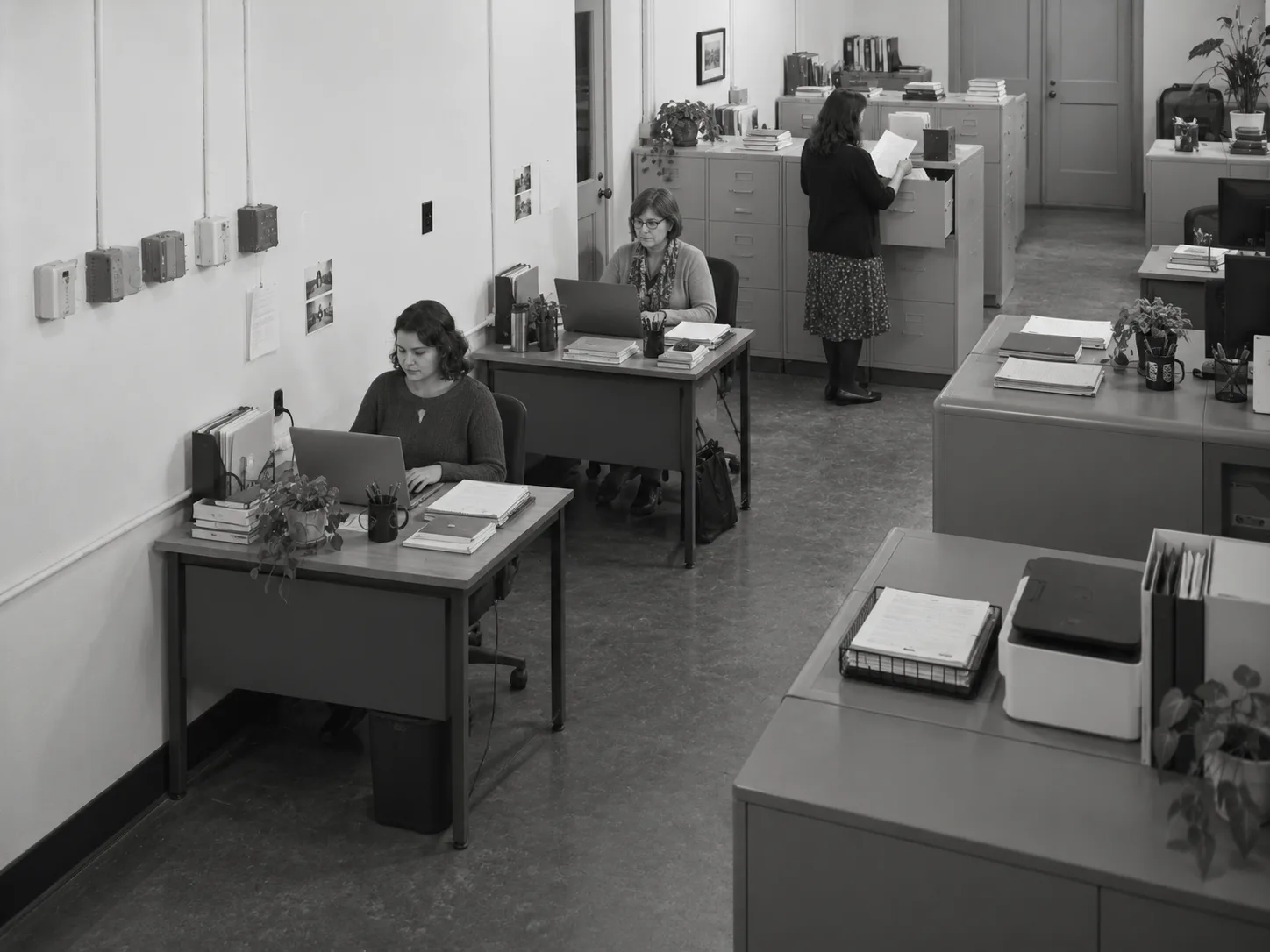
ChatGPT Images 2.0, 2026-09-05
Response to The Human Computers of 1947
Grok Imagine Video 1.5 agent (Video), 2026-09-05
Response to The Human Computers of 1947
Before it became the name of a machine, “computer” was a job performed by women.
At rows of orderly desks, a group of women bend over their work. Before electronic computers became widespread, “computer” referred first to a profession. These women read wind-tunnel film, worked through equations, and drew charts, turning violent, invisible airflows into numbers engineers could use. Today, chips perform the calculations, but people have not left the process. Who gathers the data, how labels are defined, where boundaries are set, and how results are checked still depend on human judgment and labor. Every capability a machine appears to possess is connected to a chain of human work that should not be allowed to disappear.
Computer at her work with microscope and the Friden calculating machine
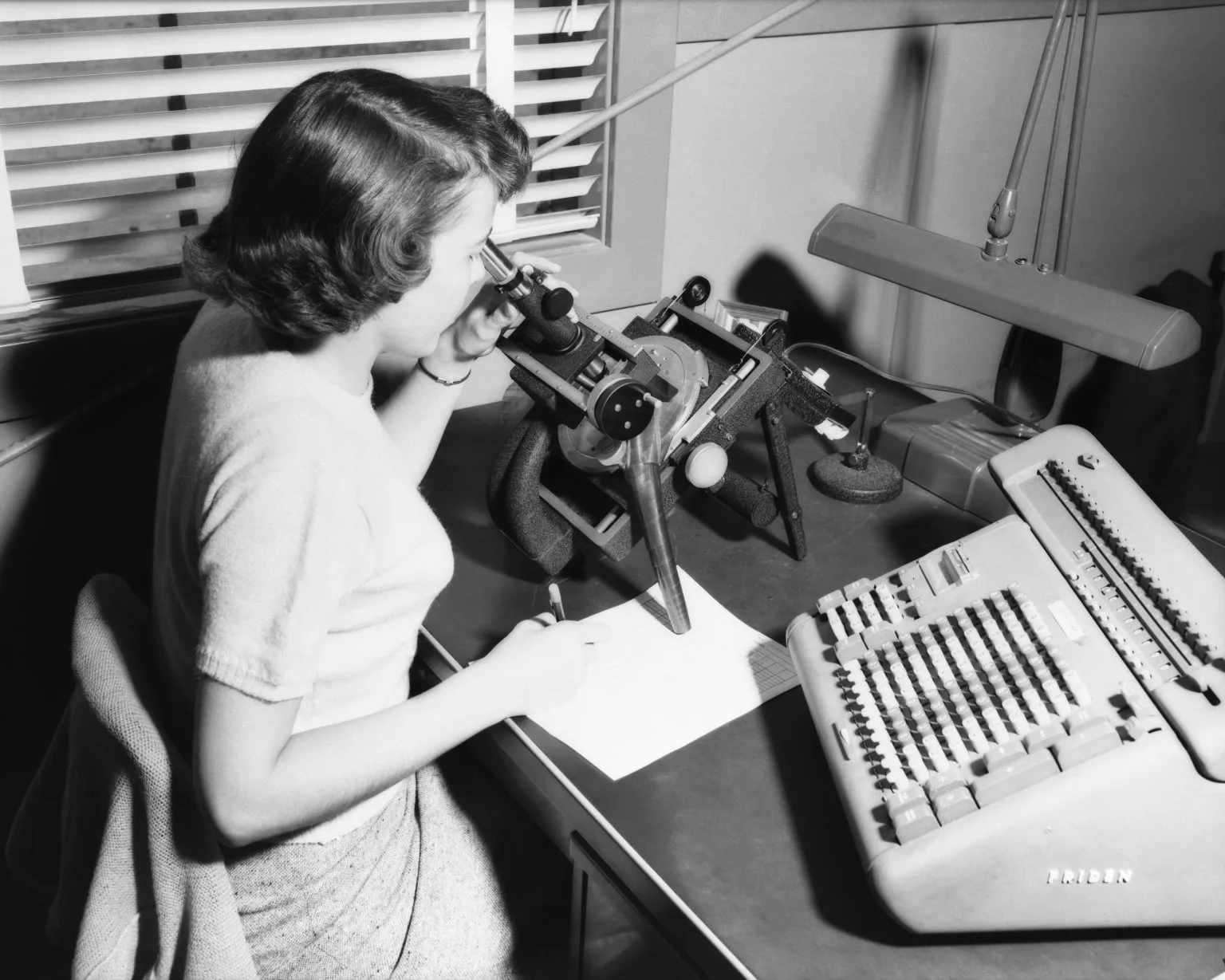
NASA / NACA institutional photograph; photographer not named, 1952NASA Langley Research Center
Computer at her work with microscope and the Friden calculating machine
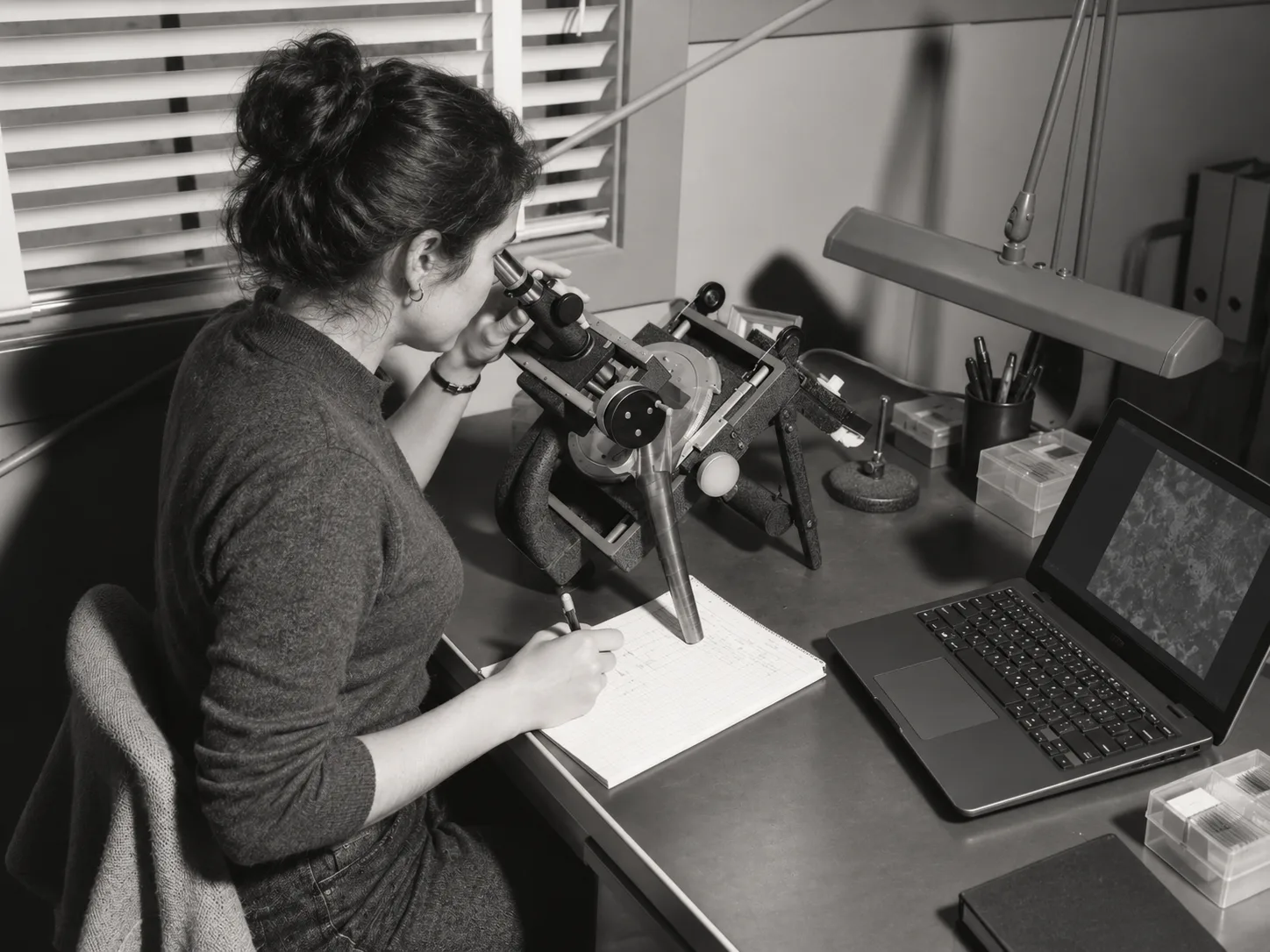
ChatGPT Images 2.0, 2026-09-05
Response to Computer at her work with microscope and the Friden calculating machine
Grok Imagine Video 1.5 agent (Video), 2026-09-05
Response to Computer at her work with microscope and the Friden calculating machine
Before data becomes an answer, hand and eye must meet.
A human computer bends over an optical microscope, a bulky mechanical calculator at her side. Looking, turning a crank, recording on paper, checking again: here a vast scientific enterprise is brought back to repeated acts of cross-checking among human senses, instruments, and records. Today’s laboratories operate on a scale of data unimaginable then, and algorithms now carry out much of the recognition and calculation. Yet experience and skepticism remain essential in asking whether the input is distorted and whether the result corresponds to physical reality. Complex models can extend reasoning, but they cannot turn a false premise into a reliable answer.
Mary W. Jackson at NASA Langley
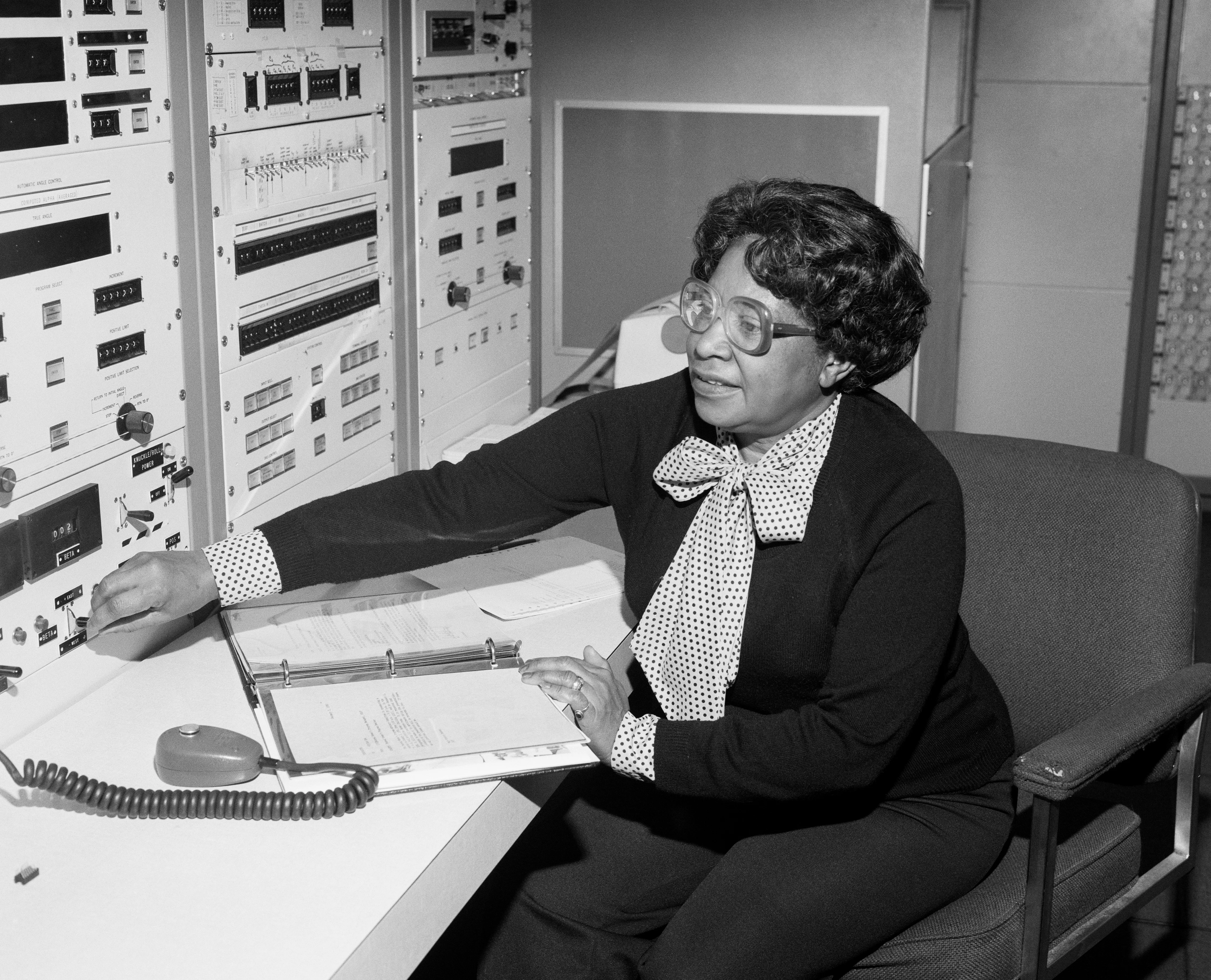
NASA Langley Research Center; photographer not named, Date not recordedNASA Langley Research Center
Mary W. Jackson at NASA Langley
Grok Imagine Video 1.5 agent (Video), 2026-09-05
Mary W. Jackson at NASA Langley
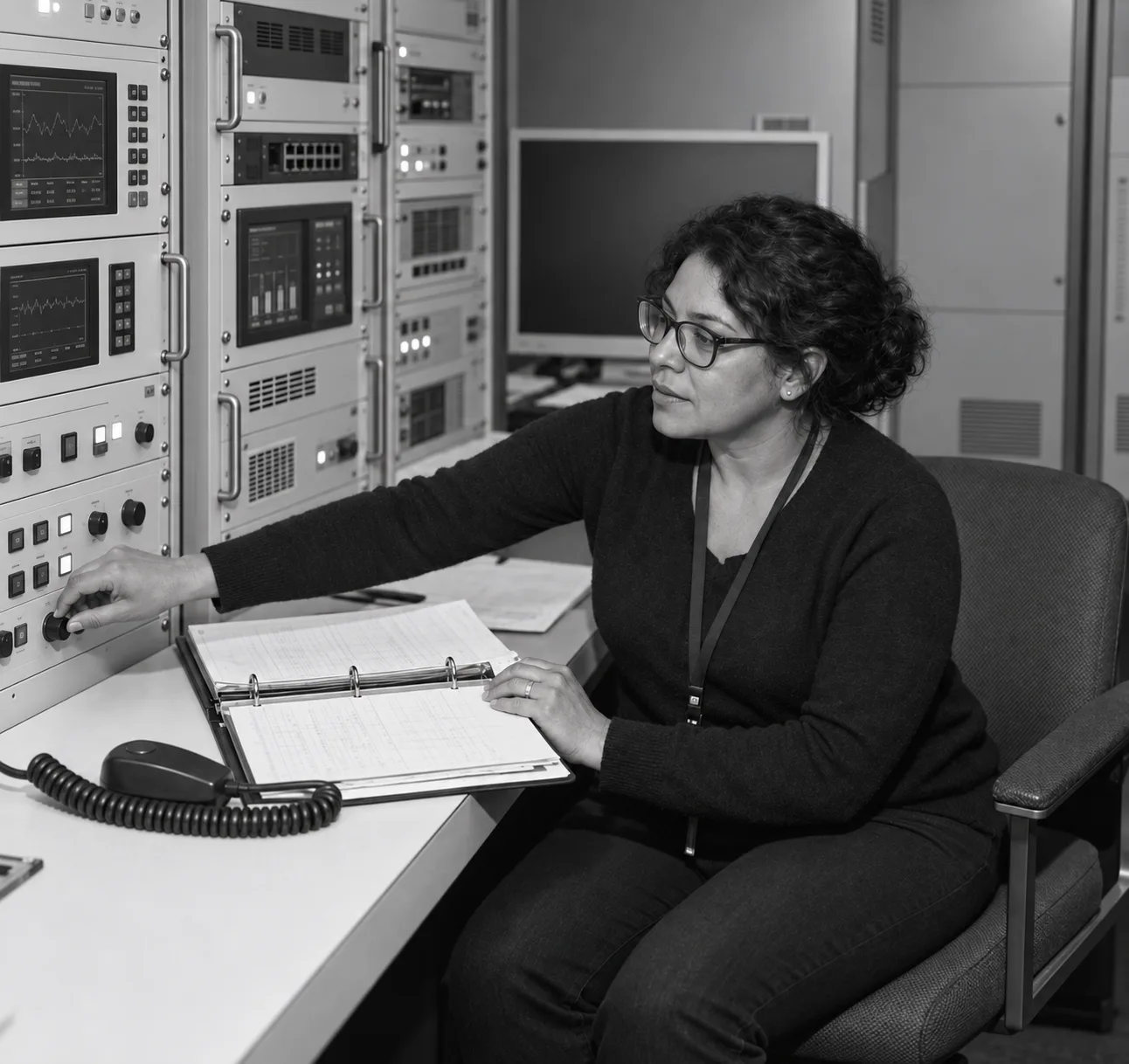
ChatGPT Images 2.0, 2026-09-05
Response to Mary W. Jackson at NASA Langley
Grok Imagine Video 1.5 agent (Video), 2026-09-05
Response to Mary W. Jackson at NASA Langley
From carrying out assigned calculations to helping rewrite the rules.
Mary Jackson sits at her desk at NASA Langley, a rack of computing equipment beside her. She began as a computer in the West Area Computing unit, crossed barriers created by institutions and prejudice, and ultimately became NASA's first Black female engineer. What changes across this pairing is not only the apparatus, but who is permitted to help write the rules. As machines take on more generative and computational tasks, the most important human role should not shrink to pressing a button. Instead, people must retain the authority to question established architectures, revise methods, and redefine the problem itself.
Mathematician Katherine Johnson at Work
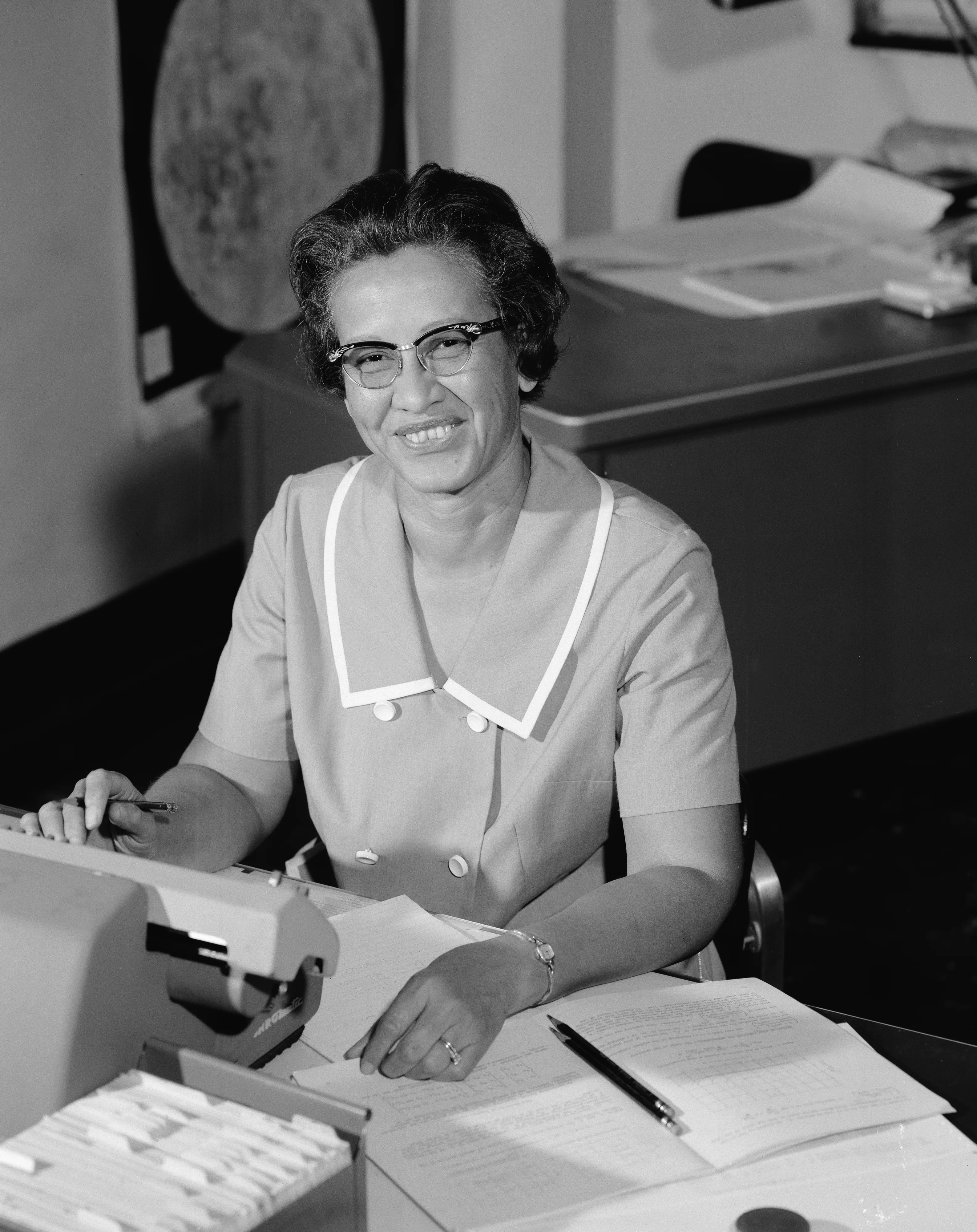
NASA Langley Research Center; photographer not named, 1966NASA Langley Research Center
Mathematician Katherine Johnson at Work
Grok Imagine Video 1.5 agent (Video), 2026-09-05
Mathematician Katherine Johnson at Work
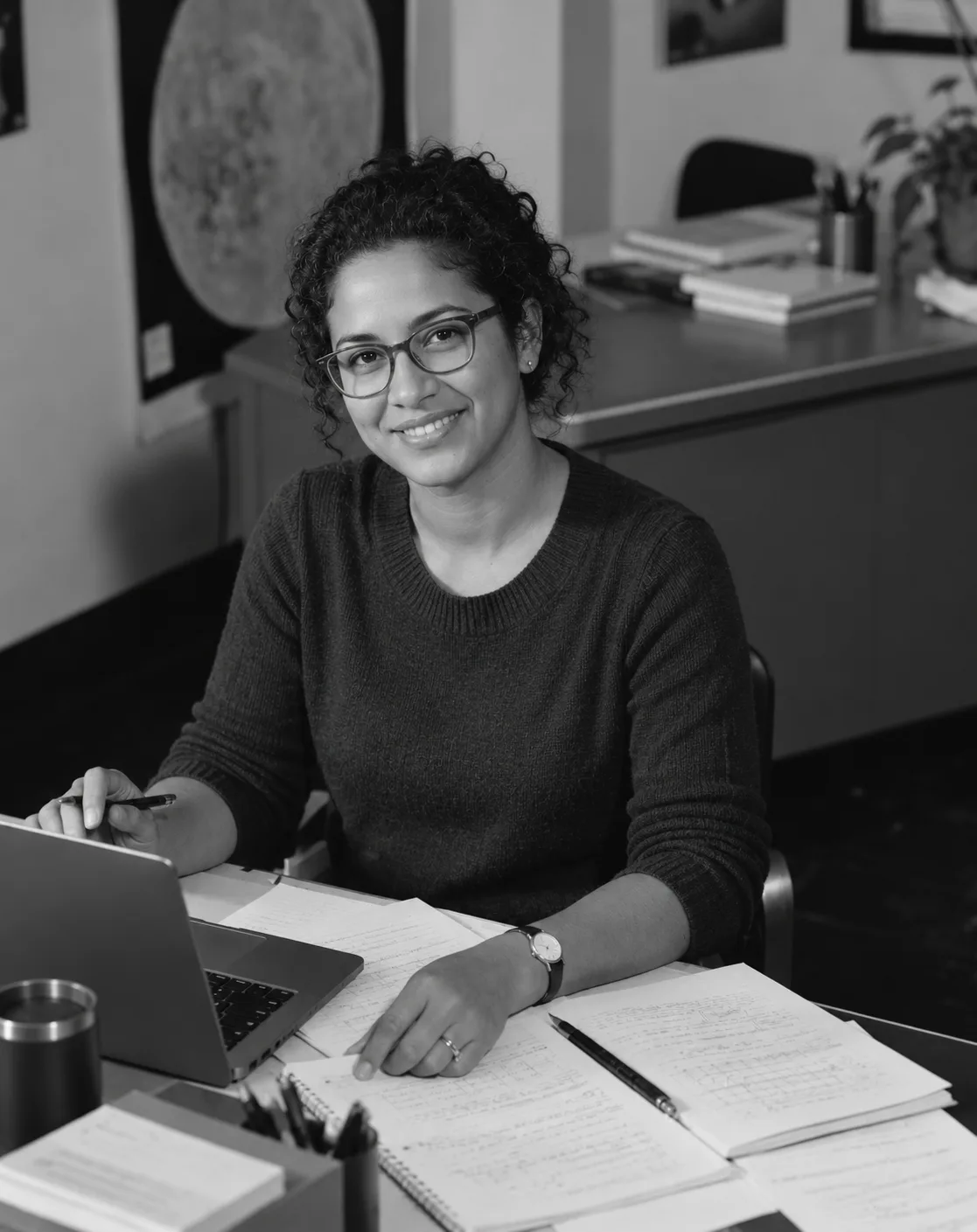
ChatGPT Images 2.0, 2026-09-05
Response to Mathematician Katherine Johnson at Work
Grok Imagine Video 1.5 agent (Video), 2026-09-05
Response to Mathematician Katherine Johnson at Work
A result must be more than computable: it must be verified and worthy of trust.
There is no blaze of a rocket launch here, only paper, pencil, and a concentrated gaze at a desk. Through hand calculation, Katherine Johnson provided crucial support for early crewed spaceflight and lunar trajectories. When an astronaut insisted that she check the numbers by hand before he would fly, calculation ceased to be merely an abstract mathematical process; it became a matter of trust on which a life depended. Fluent output and polished charts cannot replace questions about evidence, error, and limits. Verification is not the act of handing the problem back to a machine; it is the moment a human being accepts final responsibility.
IVAfter Seeing, Who Decides?
The final gallery no longer moves chronologically. Instead, every line of sight converges on a single question.
A barren valley strewn with cannonballs, a battlefield strewn with the dead, a home planet suspended in deep space.
Technology allows us to see more broadly, farther, and with greater precision. It cannot decide for us questions of life and death, sacrifice, and survival. Greater powers of observation do not make action just.
The Valley of the Shadow of Death
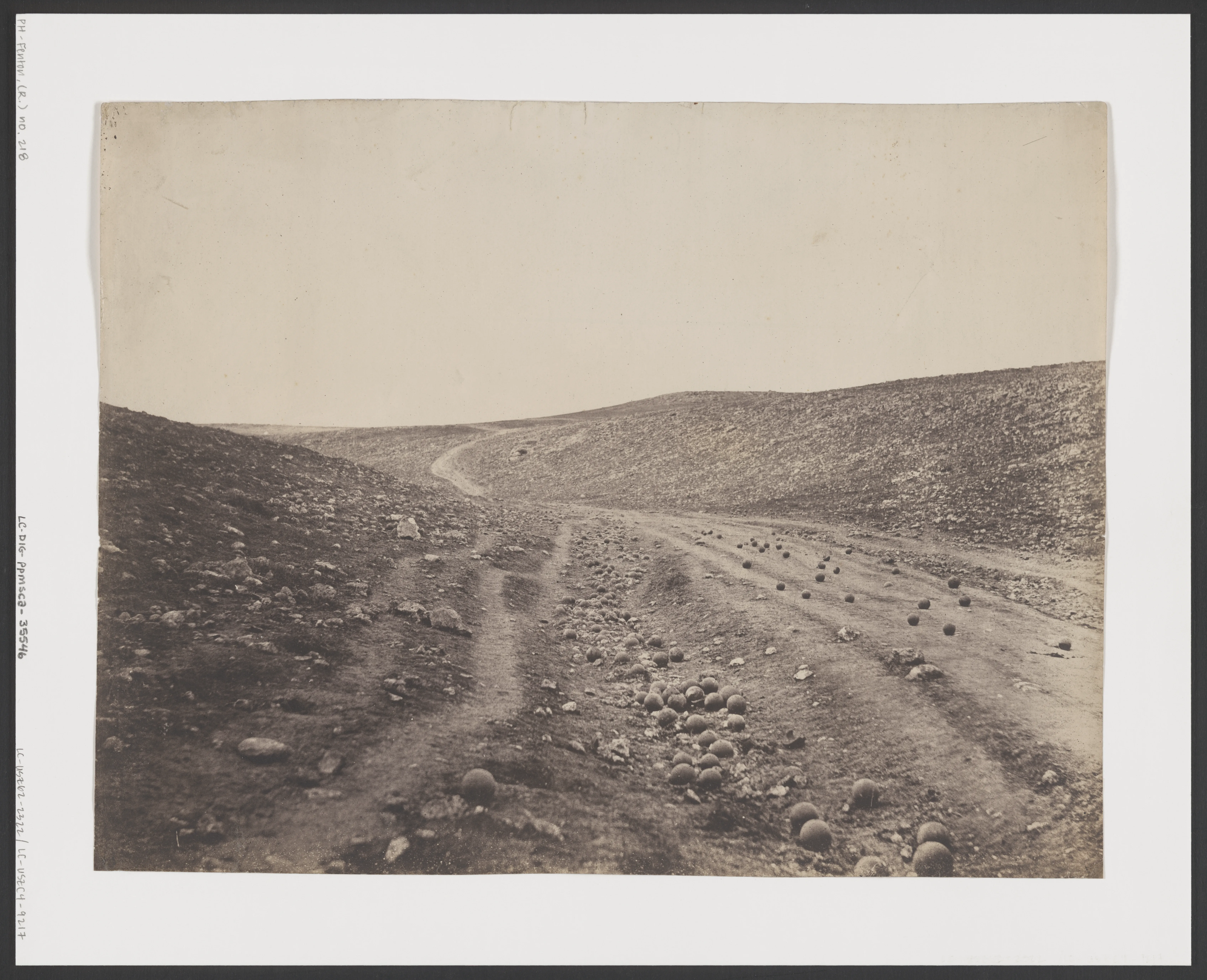
Roger Fenton, 1855Library of Congress
The Valley of the Shadow of Death
Grok Imagine Video 1.5 agent (Video), 2026-09-05
The Valley of the Shadow of Death
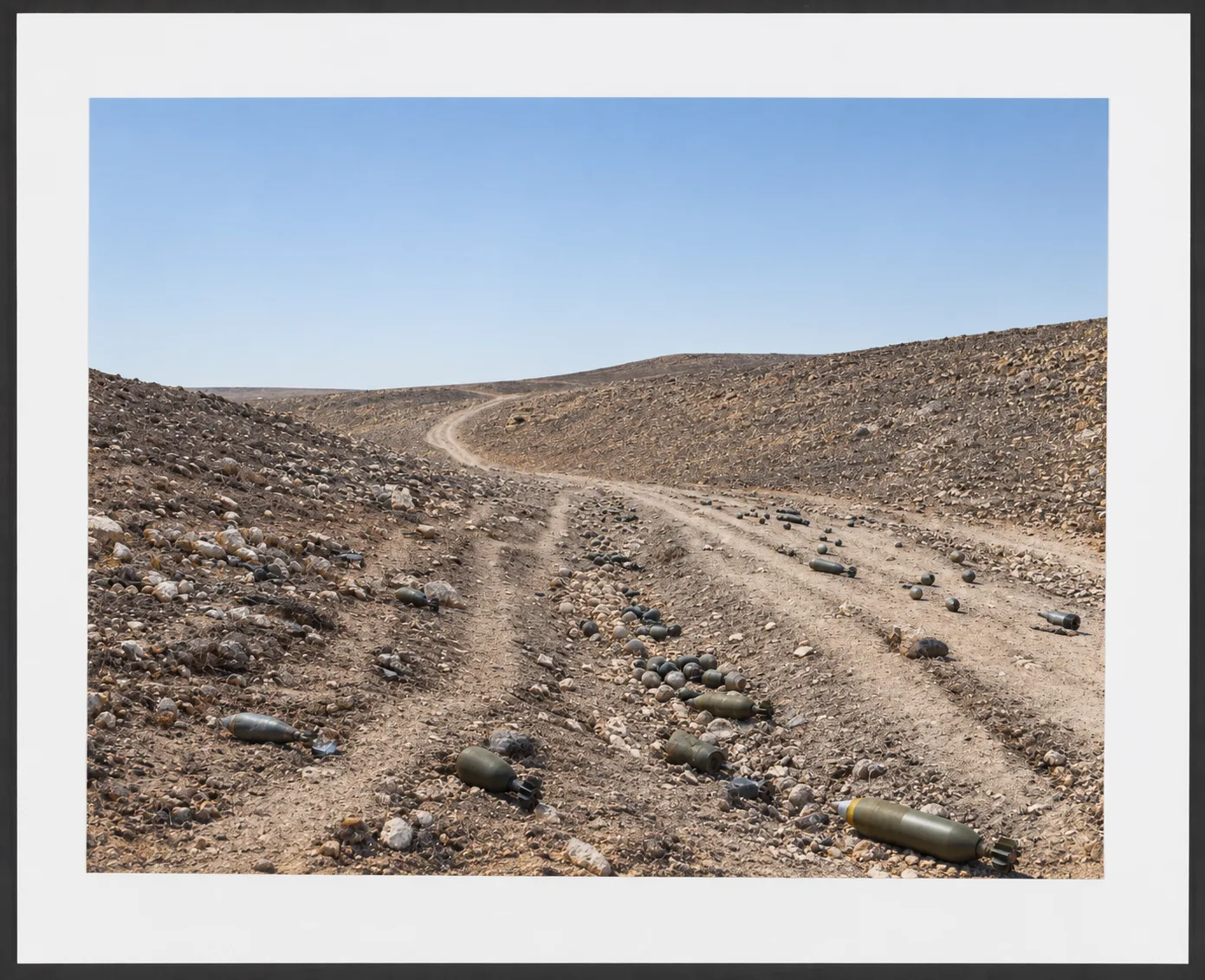
ChatGPT Images 2.0, 2026-09-05
Response to The Valley of the Shadow of Death
Grok Imagine Video 1.5 agent (Video), 2026-09-05
Response to The Valley of the Shadow of Death
Locating the cannonballs is not enough to reconstruct the truth of a war.
Black cannonballs lie scattered like stones in a ravine on the Crimean plain. There is no smoke and no flesh in the image; war appears only through what it has left behind. Another negative from the same site shows the road without cannonballs, and for more than a century viewers have debated whether the photographer moved them to heighten the image's tragic force. Today, remote-sensing and recognition systems can quickly map every crater and fragment. Location alone, however, cannot tell us who moved the cannonballs, nor can it explain a war's causes, lived experience, and trauma. Traces can be detected; the truth must still be pieced together from history, testimony, and context.
A harvest of death, Gettysburg
This work includes a historical photograph of soldiers killed on the battlefield at Gettysburg. Visitors who prefer not to view it may follow the marked route directly to Earthrise.
Skip this picture and continue to Earthrise
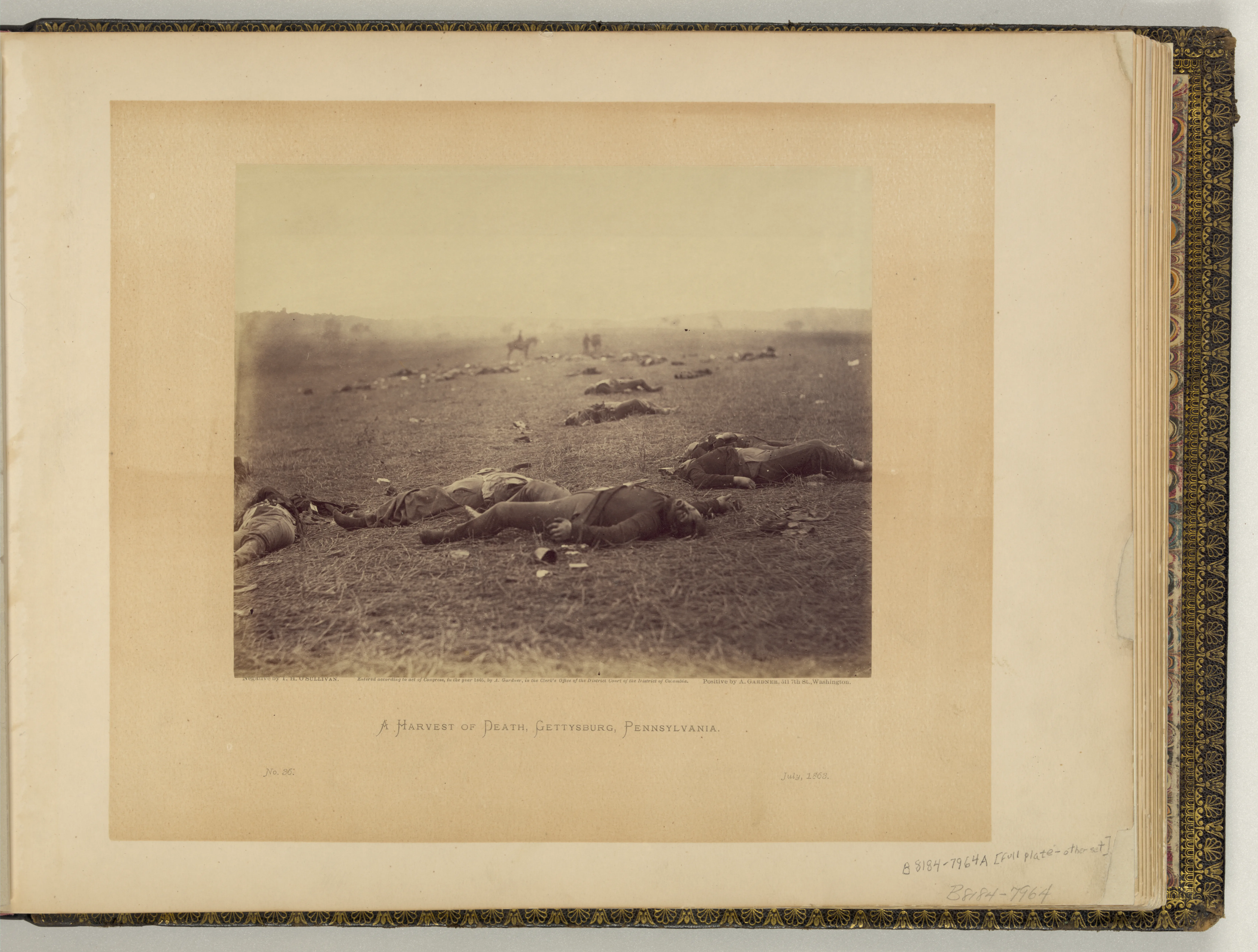
Timothy H. O’Sullivan (negative); Alexander Gardner (print), July 1863Library of Congress
A harvest of death, Gettysburg
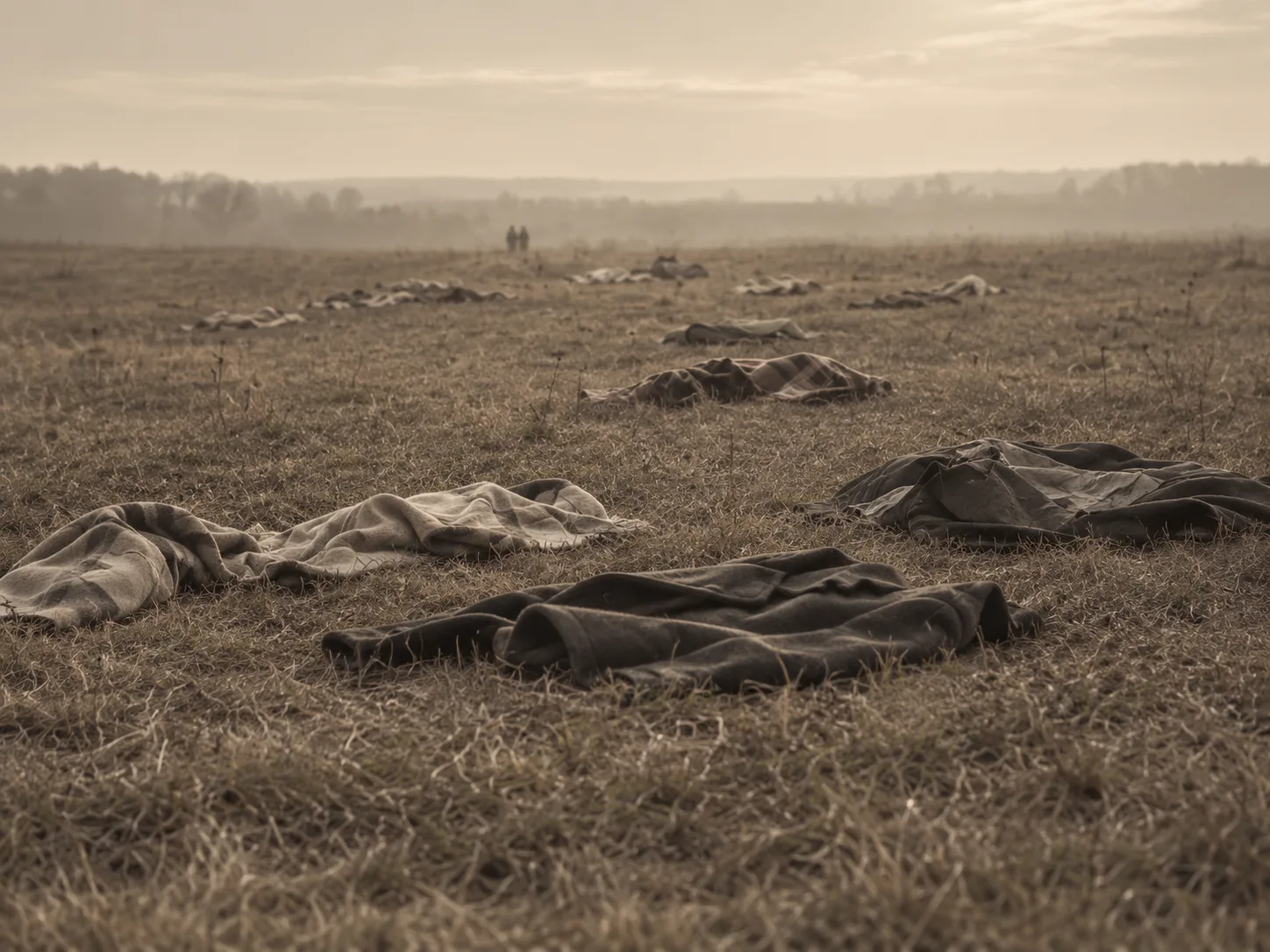
ChatGPT Images 2.0, 2026-09-05
Response to A harvest of death, Gettysburg
Grok Imagine Video 1.5 agent (Video), 2026-09-05
Response to A harvest of death, Gettysburg
Casualties may be quantified; in the mud, they remain individual human beings.
A low horizon, a distant view blurred by morning mist, bodies lying across the mud. This is not a model battlefield on which victory and defeat are calculated, but the consequence of war itself: here, a “death toll” becomes, once again, individual lives that cannot be restored. The contemporary response replaces the bodies with still memorial cloth, allowing empty space to hold absence. Today, decision systems can translate conflict into casualty ratios, heat maps, and optimization targets, and quantification can aid strategic analysis. But numbers do not lessen pain, nor can they decide what sacrifices are acceptable. Algorithms may take part in the calculation; only the people who decide can accept the cost and answer for it.
Earthrise
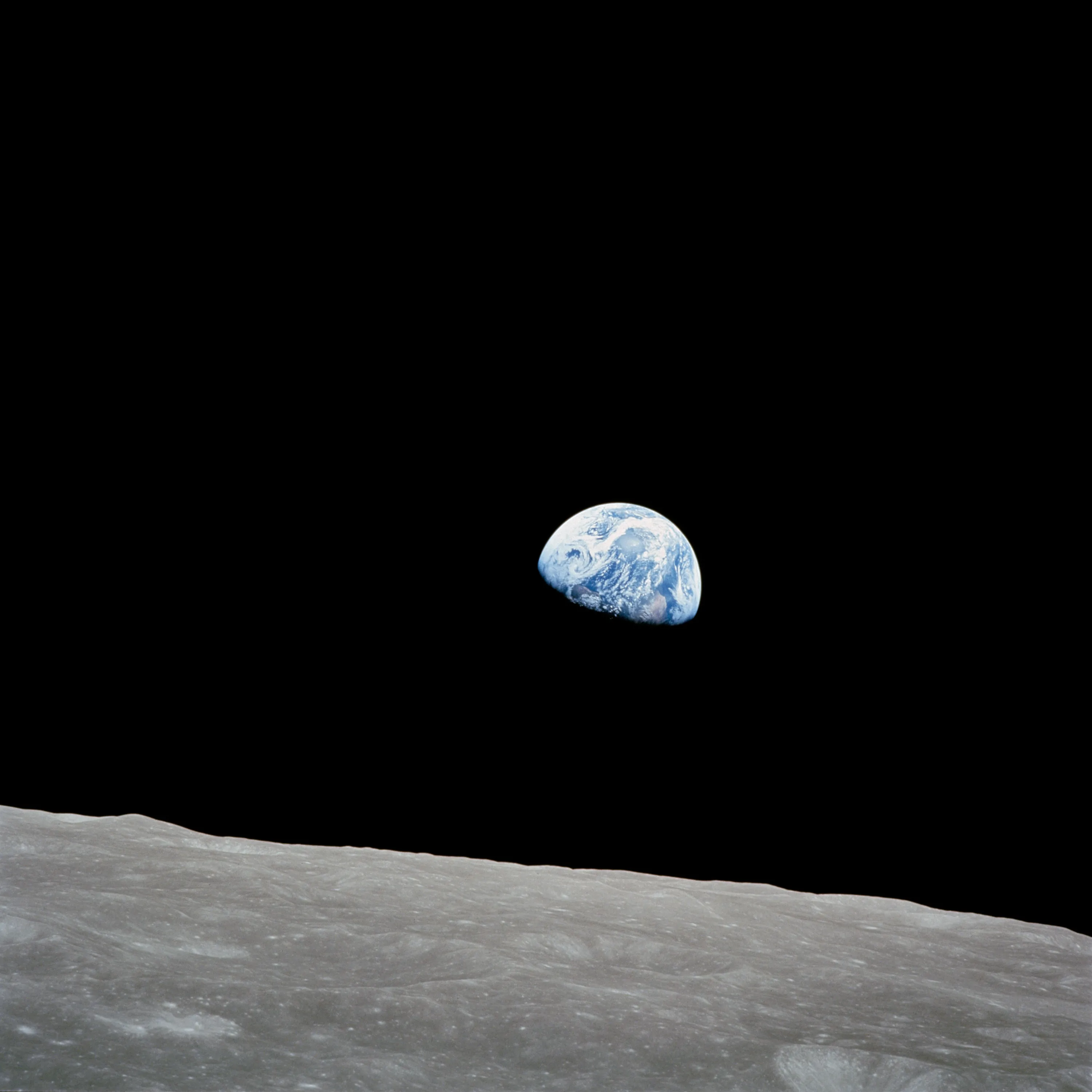
William Anders / NASA, December 24, 1968NASA / Apollo 8
Earthrise
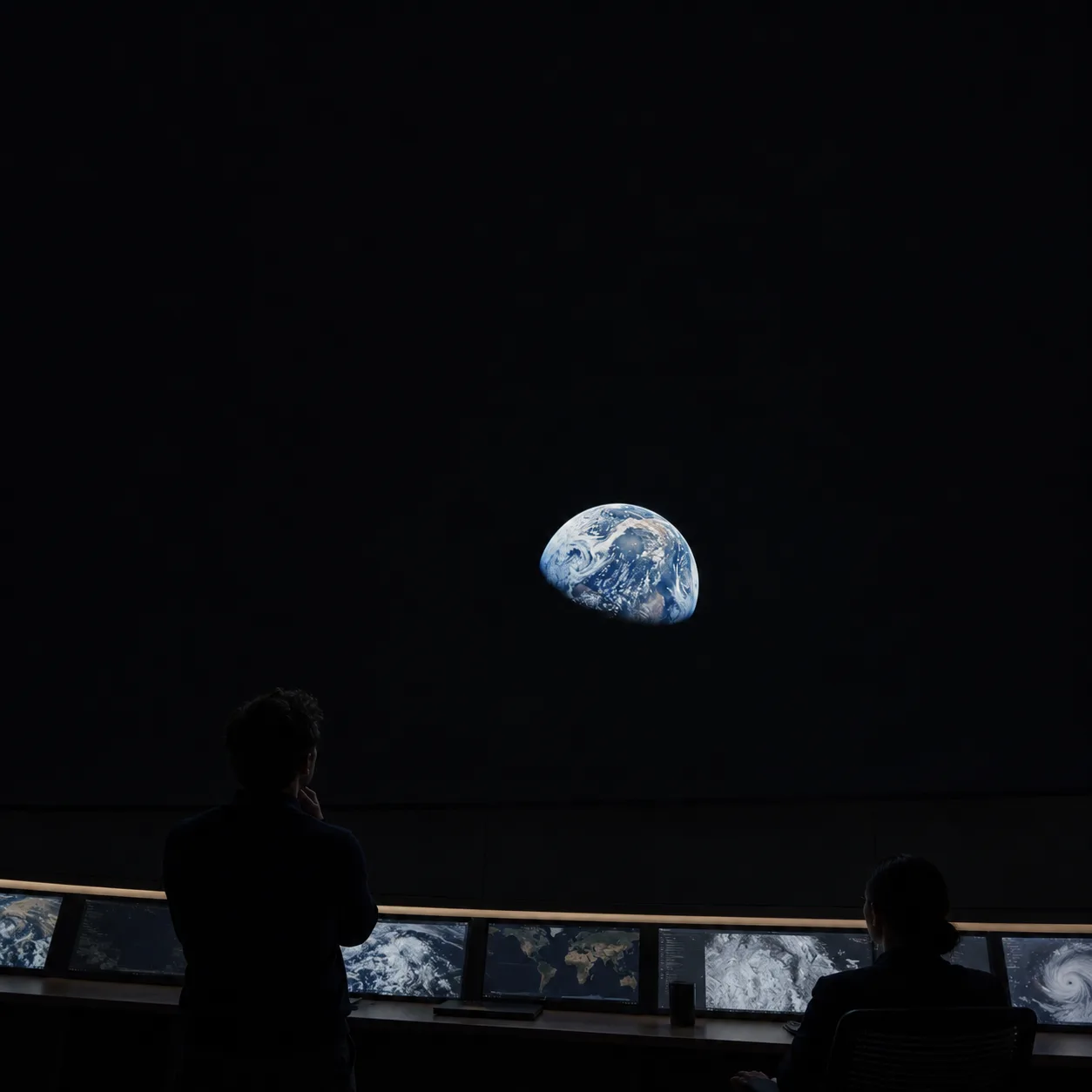
ChatGPT Images 2.0, 2026-09-05
Response to Earthrise
Grok Imagine Video 1.5 agent (Video), 2026-09-05
Response to Earthrise
From seeing our island to asking how we can live together.
On Christmas Eve in 1968, Apollo 8 emerged from behind the Moon, and Anders pressed the shutter from the spacecraft window. Above the gray lunar horizon, a blue-and-white planet rose from boundless darkness. For the first time, humanity saw its shared home from the outside and grasped with such immediacy its solitude and limits. When the view shifts to a contemporary digital observatory, Earth models and continuously updated remote-sensing data stream across the screens. We began at a half-open wooden door and have ended with an entire planet in view. Yet seeing more does not automatically tell us where to go. How we are to live together on one fragile planet remains a question humanity must answer for itself.
Afterword
These eighteen pairings across time are neither a hymn to artificial intelligence nor an exercise in nostalgia for the photographic past.
They place two ways of seeing within a single frame and examine every passage from “input” to “judgment”:
What enters the frame, and what is left outside it? Who is identified with precision, and who remains misunderstood? Who sustains the system behind the scenes, and who ultimately bears the cost of its decisions?
Tools can extend our field of vision, sharpen precision, and carry human capability to scales once beyond reach. But they cannot supply context, speak in place of particular people, or shoulder the consequences on behalf of those who decide. The names, bodies, labor, and circumstances preserved in the original photographs must not become less distinct as model outputs grow clearer and smoother.
When machines look back at us: Seeing is a technical act; understanding depends on context; judgment means taking responsibility for the consequences.
KINGDA
Sources and rights
The originals come from institutional open collections and are credited by their records. The responses and motion are AI-generated and shown as contemporary work, selected and edited by KINGDA. To republish our work, please contact us by email: kingda@kingda.me.
01 The Open Door
The Open Door
- Creator
- William Henry Fox Talbot
- Date
- Before May 1844
- Institution
- The Metropolitan Museum of Art · 2005.100.498 / Met object 283068
- Rights basis
- metmuseum.org/hubs/open-access
- Credit line
- The Metropolitan Museum of Art, Gilman Collection, Purchase, Joseph M. Cohen and Robert Rosenkranz Gifts, 2005; 2005.100.498. The Metropolitan Museum of Art marks this object’s open image Public Domain / CC0. This record covers only the specified open image.
- Processing
- Resized to reading WebP. No enlargement and no restoration.
- Reviewed
- 2026-09-06
AI motion
- Tool
- SpaceXAI · Grok Imagine Video 1.5 agent
- Generated
- 2026-09-05
Response to The Open Door
- Tool
- OpenAI · ChatGPT Images 2.0
- Generated
- 2026-09-05
AI motion
- Tool
- SpaceXAI · Grok Imagine Video 1.5 agent
- Generated
- 2026-09-05
02 The Horse in Motion
The Horse in Motion
- Creator
- Eadweard Muybridge
- Date
- 1878
- Institution
- National Gallery of Art · 2022.154.13
- Rights basis
- nga.gov/terms-and-notices
- Credit line
- National Gallery of Art, Washington, Gift of Robert B. Menschel; 2022.154.13. The National Gallery of Art Open Access notice applies to this object’s designated open image, not to every NGA webpage asset.
- Processing
- Resized to reading WebP. No enlargement and no restoration.
- Reviewed
- 2026-09-06
AI motion
- Tool
- SpaceXAI · Grok Imagine Video 1.5 agent
- Generated
- 2026-09-05
Response to The Horse in Motion
- Tool
- OpenAI · ChatGPT Images 2.0
- Generated
- 2026-09-05
AI motion
- Tool
- Google · Omni-1.1-Flash
- Generated
- 2026-09-05
03 Attitudes of Animals in Motion
Attitudes of Animals in Motion
- Creator
- Eadweard Muybridge
- Date
- Photographed 1879, printed 1881
- Institution
- The Metropolitan Museum of Art · 2015.778.33 / Met object 700109
- Rights basis
- metmuseum.org/hubs/open-access
- Credit line
- The Metropolitan Museum of Art, Gift of Joyce F. Menschel, 2015; 2015.778.33. The Metropolitan Museum of Art marks this object’s open image Public Domain / CC0. This record covers only the specified open image.
- Processing
- Resized to reading WebP. No enlargement and no restoration.
- Reviewed
- 2026-09-06
AI motion
- Tool
- SpaceXAI · Grok Imagine Video 1.5 agent
- Generated
- 2026-09-05
Response to Attitudes of Animals in Motion
- Tool
- OpenAI · ChatGPT Images 2.0
- Generated
- 2026-09-05
AI motion
- Tool
- SpaceXAI · Grok Imagine Video 1.5 agent
- Generated
- 2026-09-05
04 First flight, 120 feet in 12 seconds, 10:35 a.m.; Kitty Hawk, North Carolina
First flight, 120 feet in 12 seconds, 10:35 a.m.; Kitty Hawk, North Carolina
- Creator
- John T. Daniels / Orville Wright camera setup
- Date
- December 17, 1903
- Institution
- Library of Congress · ppprs.00626 / LC-W86-35
- Credit line
- Library of Congress, Prints & Photographs Division, Wright Brothers Negatives; LC-DIG-ppprs-00626. Shutter released by John T. Daniels; camera preset by Orville Wright. Library of Congress: no known restrictions on this item in the U.S. source record. That is not a worldwide clearance.
- Processing
- Resized to reading WebP. No enlargement and no restoration.
- Reviewed
- 2026-09-06
Response to First flight, 120 feet in 12 seconds, 10:35 a.m.; Kitty Hawk, North Carolina
- Tool
- SpaceXAI · Imagine Image 2.0
- Generated
- 2026-09-06
AI motion
- Tool
- SpaceXAI · Grok Imagine Video 1.5 agent
- Generated
- 2026-09-06
05 The steerage (1907)
The steerage (1907)
- Creator
- Alfred Stieglitz
- Date
- Photographed 1907, published 1911
- Institution
- Library of Congress · cph.3b10519 / Camera Work 36, plate IX
- Credit line
- Library of Congress, Prints & Photographs Division; Camera Work, no. 36, October 1911, plate IX; LC-USZ62-62880. Library of Congress: no known restrictions on this item in the U.S. source record. That is not a worldwide clearance.
- Processing
- Resized to reading WebP. No enlargement and no restoration.
- Reviewed
- 2026-09-06
Response to The steerage (1907)
- Tool
- OpenAI · ChatGPT Images 2.0
- Generated
- 2026-09-05
AI motion
- Tool
- SpaceXAI · Grok Imagine Video 1.5 agent
- Generated
- 2026-09-05
06 Addie Card, anaemic little spinner in North Pownal Cotton Mill
Addie Card, anaemic little spinner in North Pownal Cotton Mill
- Creator
- Lewis Wickes Hine
- Date
- August 1910
- Institution
- Library of Congress · nclc.01824 / Hine no.1050
- Rights basis
- loc.gov/rr/print/res/097_hine.html
- Credit line
- National Child Labor Committee collection, Library of Congress, Prints & Photographs Division; LC-DIG-nclc-01824. National Child Labor Committee / Lewis Hine collection: the Library of Congress records no known restrictions on this donated collection item.
- Processing
- Resized to reading WebP. No enlargement and no restoration.
- Reviewed
- 2026-09-06
Response to Addie Card, anaemic little spinner in North Pownal Cotton Mill
- Tool
- OpenAI · ChatGPT Images 2.0
- Generated
- 2026-09-05
AI motion
- Tool
- SpaceXAI · Grok Imagine Video 1.5 agent
- Generated
- 2026-09-05
07 Allie Mae Burroughs, wife of cotton sharecropper. Hale County, Alabama
Allie Mae Burroughs, wife of cotton sharecropper. Hale County, Alabama
- Creator
- Walker Evans
- Date
- Summer 1936
- Institution
- Library of Congress · fsa.8c52248 / LC-USF342-008139-A
- Rights basis
- loc.gov/rr/print/res/071_fsab.html
- Credit line
- Library of Congress, Prints & Photographs Division, FSA/OWI Collection; LC-DIG-fsa-8c52248. FSA/OWI black-and-white government photograph as recorded by the Library of Congress. Third-party works in the wider collection may differ.
- Processing
- Resized to reading WebP. No enlargement and no restoration.
- Reviewed
- 2026-09-06
Response to Allie Mae Burroughs, wife of cotton sharecropper. Hale County, Alabama
- Tool
- OpenAI · ChatGPT Images 2.0
- Generated
- 2026-09-05
AI motion
- Tool
- SpaceXAI · Grok Imagine Video 1.5 agent
- Generated
- 2026-09-05
08 Destitute pea pickers in California. Mother of seven children. Age thirty-two. Nipomo, California (Migrant Mother)
Destitute pea pickers in California. Mother of seven children. Age thirty-two. Nipomo, California (Migrant Mother)
- Creator
- Dorothea Lange
- Date
- March 1936
- Institution
- Library of Congress · fsa.8b29516 / LC-USF34-009058-C
- Rights basis
- loc.gov/rr/print/res/071_fsab.html
- Credit line
- Library of Congress, Prints & Photographs Division, FSA/OWI Collection; LC-DIG-fsa-8b29516. FSA/OWI black-and-white government photograph as recorded by the Library of Congress. Third-party works in the wider collection may differ.
- Processing
- Resized to reading WebP. No enlargement and no restoration.
- Reviewed
- 2026-09-06
Response to Destitute pea pickers in California. Mother of seven children. Age thirty-two. Nipomo, California (Migrant Mother)
- Tool
- SpaceXAI · Imagine Image 2.0
- Generated
- 2026-09-05
AI motion
- Tool
- SpaceXAI · Grok Imagine Video 1.5 agent
- Generated
- 2026-09-05
09 Young Mother Holding Her Six-Week-Old Baby
Young Mother Holding Her Six-Week-Old Baby
- Creator
- Dorothea Lange
- Date
- April 1939
- Institution
- Library of Congress · fsa.8b33507 / LC-USF34-019486-E
- Rights basis
- loc.gov/rr/print/res/071_fsab.html
- Credit line
- Library of Congress, Prints & Photographs Division, FSA/OWI Collection; LC-DIG-fsa-8b33507. FSA/OWI black-and-white government photograph as recorded by the Library of Congress. Third-party works in the wider collection may differ.
- Processing
- Resized to reading WebP. No enlargement and no restoration.
- Reviewed
- 2026-09-06
Response to Young Mother Holding Her Six-Week-Old Baby
- Tool
- SpaceXAI · Imagine Image 2.0
- Generated
- 2026-09-05
AI motion
- Tool
- SpaceXAI · Grok Imagine Video 1.5 agent
- Generated
- 2026-09-05
10 Mother Seeking Help at a Camp
Mother Seeking Help at a Camp
- Creator
- Dorothea Lange
- Date
- April 1939
- Institution
- Library of Congress · fsa.8b33516 / LC-USF34-019495-E
- Rights basis
- loc.gov/rr/print/res/071_fsab.html
- Credit line
- Library of Congress, Prints & Photographs Division, FSA/OWI Collection; LC-DIG-fsa-8b33516. FSA/OWI black-and-white government photograph as recorded by the Library of Congress. Third-party works in the wider collection may differ.
- Processing
- Resized to reading WebP. No enlargement and no restoration.
- Reviewed
- 2026-09-06
Response to Mother Seeking Help at a Camp
- Tool
- SpaceXAI · Imagine Image 2.0
- Generated
- 2026-09-05
AI motion
- Tool
- SpaceXAI · Grok Imagine Video 1.5 agent
- Generated
- 2026-09-05
11 Washington, D.C. Government charwoman
Washington, D.C. Government charwoman
- Creator
- Gordon Parks
- Date
- 1942
- Institution
- Library of Congress · fsa.8b14845 / LC-USF34-013407-C
- Rights basis
- loc.gov/rr/print/res/071_fsab.html
- Credit line
- Library of Congress, Prints & Photographs Division, FSA/OWI Collection; LC-DIG-fsa-8b14845. FSA/OWI black-and-white government photograph as recorded by the Library of Congress. Third-party works in the wider collection may differ. Selected FSA original negative only; not a later museum print that carries a foundation copyright claim.
- Processing
- Resized to reading WebP. No enlargement and no restoration.
- Reviewed
- 2026-09-06
Response to Washington, D.C. Government charwoman
- Tool
- SpaceXAI · Imagine Image 2.0
- Generated
- 2026-09-05
AI motion
- Tool
- SpaceXAI · Grok Imagine Video 1.5 agent
- Generated
- 2026-09-05
12 The Human Computers of 1947
The Human Computers of 1947
- Creator
- NASA / NACA institutional photograph; photographer not named
- Date
- January 28, 1947
- Institution
- NASA on The Commons · LRC-1947-B701_P-51533
- Rights basis
- nasa.gov/nasa-brand-center/images-and-media/
- Credit line
- NASA, Langley Research Center historical archive; LRC-1947-B701_P-51533. Originally a NACA workplace. NASA media-usage guidelines: editorial exhibition with credit. Not an endorsement, not advertising, not a NASA-branded AI output.
- Processing
- Resized to reading WebP. No enlargement and no restoration.
- Reviewed
- 2026-09-06
Response to The Human Computers of 1947
- Tool
- OpenAI · ChatGPT Images 2.0
- Generated
- 2026-09-05
AI motion
- Tool
- SpaceXAI · Grok Imagine Video 1.5 agent
- Generated
- 2026-09-05
13 Computer at her work with microscope and the Friden calculating machine
Computer at her work with microscope and the Friden calculating machine
- Creator
- NASA / NACA institutional photograph; photographer not named
- Date
- 1952
- Institution
- NASA Langley Research Center · LRC-1952-B701_P-74753
- Rights basis
- nasa.gov/nasa-brand-center/images-and-media/
- Credit line
- NASA, Langley Research Center historical archive; LRC-1952-B701_P-74753. NASA media-usage guidelines: editorial exhibition with credit. Not an endorsement, not advertising, not a NASA-branded AI output.
- Processing
- Resized to reading WebP. No enlargement and no restoration.
- Reviewed
- 2026-09-06
Response to Computer at her work with microscope and the Friden calculating machine
- Tool
- OpenAI · ChatGPT Images 2.0
- Generated
- 2026-09-05
AI motion
- Tool
- SpaceXAI · Grok Imagine Video 1.5 agent
- Generated
- 2026-09-05
14 Mary W. Jackson at NASA Langley
Mary W. Jackson at NASA Langley
- Creator
- NASA Langley Research Center; photographer not named
- Date
- Date not recorded
- Institution
- NASA Langley Research Center · LRC-1980-B701_P-00042
- Rights basis
- nasa.gov/nasa-brand-center/images-and-media/
- Credit line
- NASA Langley Research Center. Historical context consulted in the NASA image-article record. NASA media-usage guidelines: editorial exhibition with credit. Not an endorsement, not advertising, not a NASA-branded AI output.
- Processing
- Resized to reading WebP. No enlargement and no restoration.
- Reviewed
- 2026-09-06
AI motion
- Tool
- SpaceXAI · Grok Imagine Video 1.5 agent
- Generated
- 2026-09-05
Response to Mary W. Jackson at NASA Langley
- Tool
- OpenAI · ChatGPT Images 2.0
- Generated
- 2026-09-05
AI motion
- Tool
- SpaceXAI · Grok Imagine Video 1.5 agent
- Generated
- 2026-09-05
15 Mathematician Katherine Johnson at Work
Mathematician Katherine Johnson at Work
- Creator
- NASA Langley Research Center; photographer not named
- Date
- 1966
- Institution
- NASA Langley Research Center · NASA article: mathematician-katherine-johnson-work; 1966 desk photograph
- Rights basis
- nasa.gov/nasa-brand-center/images-and-media/
- Credit line
- NASA Langley Research Center, Katherine Johnson at her desk, 1966. NASA media-usage guidelines: editorial exhibition with credit. Not an endorsement, not advertising, not a NASA-branded AI output.
- Processing
- Resized to reading WebP. No enlargement and no restoration.
- Reviewed
- 2026-09-06
AI motion
- Tool
- SpaceXAI · Grok Imagine Video 1.5 agent
- Generated
- 2026-09-05
Response to Mathematician Katherine Johnson at Work
- Tool
- OpenAI · ChatGPT Images 2.0
- Generated
- 2026-09-05
AI motion
- Tool
- SpaceXAI · Grok Imagine Video 1.5 agent
- Generated
- 2026-09-05
16 The Valley of the Shadow of Death
The Valley of the Shadow of Death
- Creator
- Roger Fenton
- Date
- 1855
- Institution
- Library of Congress · ppmsca.35546 / PH-Fenton no.218
- Credit line
- Library of Congress, Prints & Photographs Division, Roger Fenton Crimean War photograph collection; LC-DIG-ppmsca-35546. Library of Congress: no known restrictions on this item in the U.S. source record. That is not a worldwide clearance.
- Processing
- Resized to reading WebP. No enlargement and no restoration.
- Reviewed
- 2026-09-06
AI motion
- Tool
- SpaceXAI · Grok Imagine Video 1.5 agent
- Generated
- 2026-09-05
Response to The Valley of the Shadow of Death
- Tool
- OpenAI · ChatGPT Images 2.0
- Generated
- 2026-09-05
AI motion
- Tool
- SpaceXAI · Grok Imagine Video 1.5 agent
- Generated
- 2026-09-05
17 A harvest of death, Gettysburg
A harvest of death, Gettysburg
- Creator
- Timothy H. O’Sullivan (negative); Alexander Gardner (print)
- Date
- July 1863
- Institution
- Library of Congress · ppmsca.12557 / Gardner book vol.1 plate36
- Credit line
- Library of Congress, Prints & Photographs Division; negative by T. H. O’Sullivan, positive by Alexander Gardner; LC-DIG-ppmsca-12557. Library of Congress: no known restrictions on this item in the U.S. source record. That is not a worldwide clearance.
- Processing
- Resized to reading WebP. No enlargement and no restoration.
- Reviewed
- 2026-09-06
Response to A harvest of death, Gettysburg
- Tool
- OpenAI · ChatGPT Images 2.0
- Generated
- 2026-09-05
AI motion
- Tool
- SpaceXAI · Grok Imagine Video 1.5 agent
- Generated
- 2026-09-05
18 Earthrise
Earthrise
- Creator
- William Anders / NASA
- Date
- December 24, 1968
- Institution
- NASA / Apollo 8 · AS08-14-2383
- Rights basis
- nasa.gov/nasa-brand-center/images-and-media/
- Credit line
- NASA / Apollo 8, photograph by William Anders; AS08-14-2383. NASA media-usage guidelines: editorial exhibition with credit. Not an endorsement, not advertising, not a NASA-branded AI output.
- Processing
- Resized to reading WebP. No enlargement and no restoration.
- Reviewed
- 2026-09-06
Response to Earthrise
- Tool
- OpenAI · ChatGPT Images 2.0
- Generated
- 2026-09-05
AI motion
- Tool
- SpaceXAI · Grok Imagine Video 1.5 agent
- Generated
- 2026-09-05