Edition note. This English edition is a language-only translation and light copyedit of the 2023 Japanese original. The argument, structure, data, figures, tables, and references have not been substantively revised.
Abstract
This paper focuses on the food crisis and examines short-term and long-term programmes for achieving food security from perspectives that differ in urgency and time horizon: problems that require immediate resolution, and the complete eradication of hunger.
In the short-term programme, drawing on the effects of the Black Sea Grain Initiative, the paper argues that strengthening international cooperation and expanding a shared humanitarian understanding among states are the most direct means of stabilising food prices. The discussion of donation boxes and the private sector aims to develop methods of financing WFP humanitarian assistance in order to compensate for governments’ lack of willingness to provide support, thereby enabling responses to emergencies caused by food shortages. At the end of the short-term programme, the paper briefly explains how trust, as the bond in relations between states and between donors and recipients, lays the foundation for solving long-term problems.
The long-term programme focuses on the legal basis for returning food to a human-rights framework, considers the direction of future action by governments and the United Nations, and uses internet search data on the food crisis to present the problem of insufficient latent attention to the goal of Zero Hunger. On this basis, it proposes approaches for future action.
There is no uniform and perfect solution to food problems. Only by first addressing the most urgent problems and the people confronting food crises, and by continuing action to protect lives, can the existing obstacles to Zero Hunger be overcome. Mutual assistance among states, the United Nations, humanitarian organisations, and people can give food security a strong and sustainable impetus.
Introduction
The impact of the COVID-19 pandemic on food markets has not yet dissipated, and the Russia-Ukraine war has delivered a new shock to global food security. According to FAO data, the Food Price Index reached 140.6 in 2022, continuing to rise from 125.1 in the previous year, and Figure 1 shows the sharp increase. Rising food prices are directly connected to a new food crisis. In 2021, an estimated 702 million to 828 million people worldwide faced hunger, an increase of 46 million people from the previous year.1
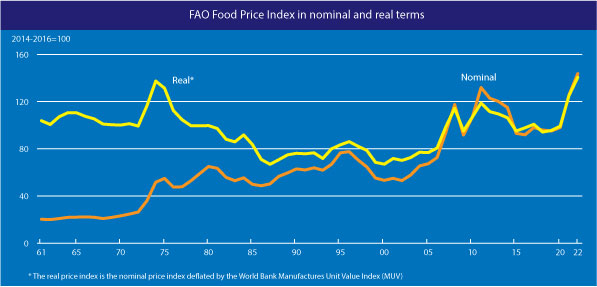
Source: World Food Situation, FAO Food Price Index, FAO.
The Russia-Ukraine war has had a devastating impact on food security beyond the supply-chain disruption caused by COVID-19. FAO’s Maximo Cullen stated: “The war has halted exports from Ukraine and Russia, two major grain exporters. Globally, about 50 countries obtain more than 30 per cent of their grain imports from these two countries, and about 20 countries obtain more than 50 per cent. Russia is the world’s largest exporter of nitrogen fertiliser, the second-largest exporter of potash fertiliser, and the third-largest exporter of phosphate fertiliser. If Russia stops exporting fertiliser, it will push up chemical fertiliser prices, which were already high before the war, placing a heavy burden on farmers.”2 In addition to stalled grain exports and rising fertiliser prices, the increase in energy prices caused by the war has raised food companies’ production costs and indirectly increased consumer food prices. Together, these adverse factors are imposing a heavy burden on the world’s population.
The complexity of the food system has made the food crisis a difficult problem. Ensuring that people around the world can obtain safe, affordable, and nutritious food is not easy. It requires progress to be made simultaneously in many areas, including energy, trade, climate change, and distribution mechanisms. Yet uncertainty in the world continues to grow, and conflicts over national interests are crowding out the space for peace and development.
Under such circumstances, nothing is more important than action. Everything done to safeguard human well-being is necessary and worthy of respect. We should first address the problems before us, and then think about tomorrow and the future. Survival is the precondition for development; the present is the starting point of the distant future; and we have a duty to rescue one another from suffering and death.
Immediate Priorities: International Cooperation, Fundraising, and Restoring Trust
1.1 The Power of International Cooperation
Even as the harmful effects of the Russia-Ukraine war continue to spread, it is possible to find a “ray of hope.” On 22 July 2022, representatives of Russia, Ukraine, Türkiye, and the United Nations signed the Black Sea Grain Initiative in Istanbul. The initiative enabled grain and other food products to be exported from three major Ukrainian ports to destinations around the world through a safe maritime humanitarian corridor. At the same time, the United Nations signed a separate memorandum of understanding with Russia concerning access to world markets for Russian grain and fertiliser products, including ammonia.3
The initiative produced results quickly. As of 18 January 2023, 17.8 million tonnes of grain, oilseeds, and other food products had been exported under the initiative, with maize and wheat as the most important exports.4 This outcome was directly connected to the stabilisation of wheat and maize prices following their decline in mid-May 2022. Although there were small fluctuations, Figure 2 shows that prices did not rise dramatically. At the same time, because of the initiative, the Food Price Index fell from 140.6 in July 2022 to 132.4 in December. Although this remained far above the pre-pandemic level of 95.1 in 2019,5 it had fallen back to the level before the Russia-Ukraine war.
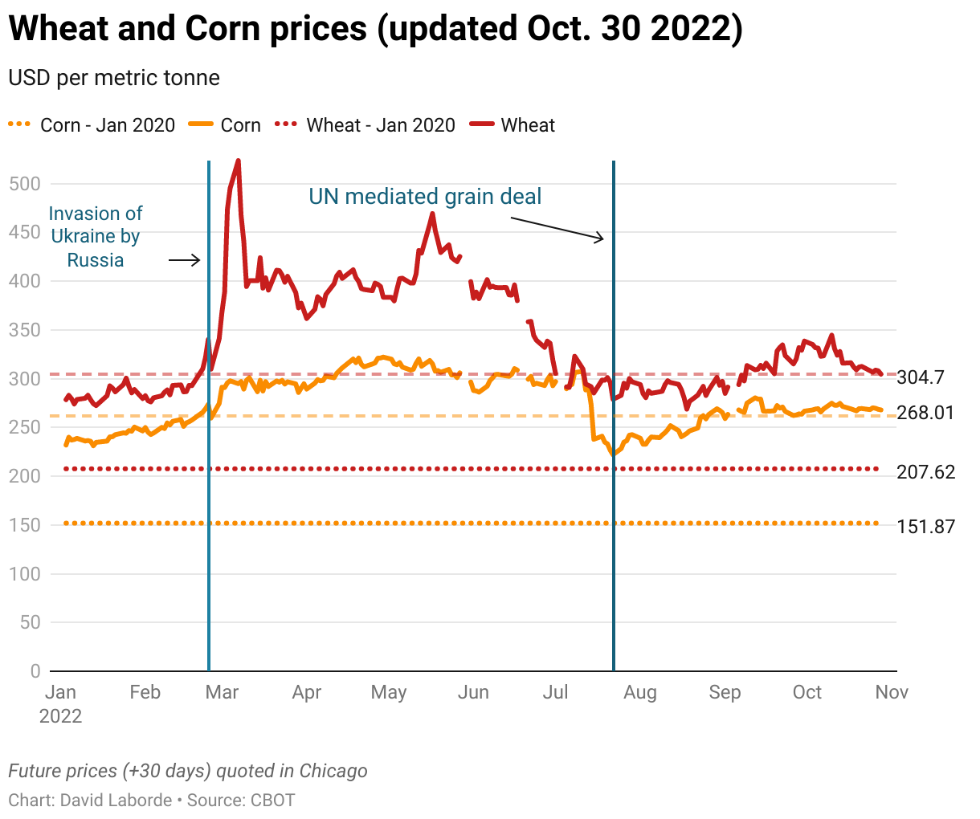
Source: CBOT (chart by David Laborde).
The effectiveness of the Black Sea Grain Initiative reminds us that, despite major conflicts of interest among states, international cooperation is the most efficient means of bringing a crisis under control. States may be unable to reach agreement at the level of sovereign interests, but a humanitarian understanding still exists, and it is important to consolidate and expand it.
At the same time, in order to give producers and consumers greater reassurance, the United Nations should continue working with governments to determine whether multilateral agreements such as the Black Sea Grain Initiative can be extended to the energy sector, thereby further reducing food production costs. Sanctions on Russian energy exports are intended to stop the war, but their spillover effects also reach the food sector, raising the production costs of processed foods and indirectly expanding the effects of the food crisis. Ending the war is one of the most direct ways to end the crisis. However, when a short-term ceasefire is unlikely, countries whose interests differ from Russia’s need to agree on sanctions with limited chain effects in order to reduce the impact on uninvolved states whose food and energy systems depend on imports or which require urgent assistance. Point-to-point humanitarian compensation should also be considered as one possible option.
1.2 Expanding WFP Funding Channels
Emergency humanitarian assistance, in addition to international cooperation, is another important means of alleviating the crisis. Because humanitarian organisations have few direct conflicts of interest with countries around the world, states tend to be more open to assistance from them, making it easier to support countries where aid is needed most.
In June 2020, United Nations Secretary-General António Guterres said at a high-level meeting: “We must focus on the places where the risk is most severe and mobilise to protect lives and livelihoods.”6 WFP has consistently appeared in countries with the most unstable food conditions. It has repeatedly carried out emergency relief operations in countries such as Yemen, the Democratic Republic of the Congo, and South Sudan, where assistance is indispensable because reliable access to adequate and nutritious food is often unavailable. In Yemen, WFP conducted its largest-ever food assistance operation, increasing the number of people supported from one million in 2015 to nearly thirteen million in 2019, and effectively prevented a large-scale famine.
At the WTO’s Twelfth Ministerial Conference, WFP received an exemption from member states’ food export restrictions, enabling it to procure food for support in the most dangerous regions.7 However, because WFP is a humanitarian organisation funded by donations, it cannot be said to have sufficient resources. Owing to the non-profit nature of humanitarianism, governments have little incentive to provide funding, and because donors receive no measurable return from their contributions, funding is not a profit-oriented choice. In 2022, the organisation received US$14.1 billion in contributions. The United States was the largest donor at US$7.2 billion, followed by Germany at US$1.7 billion and the European Commission at US$690 million.8 The gap of US$5.5 billion between the first- and second-largest contributors indicates the limited willingness of governments to contribute. At the same time, WFP’s costs also rose in step with food-price increases caused by supply-chain disruption and the Russia-Ukraine war. The organisation required US$12.3 billion in 20219 to meet its operational needs, and stated that the amount would jump to US$24 billion in 2022.10 WFP possesses both the exemption from export restrictions and the expertise needed to alleviate hunger and fight famine, but it urgently requires funding to achieve these goals.
Among the many contributors, the newly emerging private sector - companies, individuals, and foundations - deserves attention.i As Figure 3 shows, its contribution amounts continued to rise. In the three years from 2020 to 2022, the private sector contributed more than US$160 million, US$200 million, and US$520 million respectively to WFP. Its contribution ranking rose from tenth to ninth, and then advanced past many countries to fourth.
| Year | Amount (US dollars) | Contribution ranking |
|---|---|---|
| 2020 | 160,664,795 | 10 |
| 2021 | 205,295,029 | 9 |
| 2022 | 527,966,270 | 4 |
Source: Contributions to WFP by year, WFP.
i The scope of the “private sector” is taken from WFP/EB.A/2021/4-A*. ↩︎
The performance of the private sector provides a reason to expand funding sources. Governments remain the most important contributors, but their contribution amounts tend to fluctuate within a stable range and do not have the potential for much larger additions. For example, as Figure 4 shows, the United Kingdom contributed approximately US$540 million in 2020 and ranked third. Its contribution fell to approximately US$370 million in 2021, and in 2022 it rose slightly by about US$50 million. This is an inevitable result of “national priorities and fiscal constraints in competition among countries,”11 together with governments’ lack of motivation to assume greater responsibility for non-profit activities. Private-sector donations to humanitarian organisations are also non-profit in principle, but the improvement of the social reputation of companies and foundations provides a clear beneficial feedback, which can give further momentum to private-sector donations. In addition, the power of individuals cannot be ignored.
| Year | Amount (US dollars) | Contribution ranking |
|---|---|---|
| 2020 | 548,971,792 | 3 |
| 2021 | 376,260,054 | 4 |
| 2022 | 418,234,455 | 6 |
Source: Contributions to WFP by year, WFP.
Individuals are often regarded as the weakest part of the private sector, but Japan’s experience shows otherwise. The key question is whether organisations that need funding provide individuals with a channel through which to contribute. In Japan, convenience stores are inseparable from daily life. A small green box known as a donation box is placed at the checkout counter of each convenience store. Customers can place coins they do not wish to keep into the box, and the money is then donated to various humanitarian organisations. Most of the coins have small denominations, mainly the light one-yen and five-yen coins, but this inconspicuous small box plays an important role. According to Japan’s three major convenience-store companies - 7-Eleven, Lawson, and FamilyMart - since donation boxes were introduced around 1990, approximately ¥8.79 billion, ¥10.8 billion, and ¥4.9 billion respectively have been donated.12 These funds have made a major contribution to humanitarian assistance.
This is a typical example of a business providing individuals with a route for donating. In this case, individuals, companies, and humanitarian organisations form a perfect loop. Individuals can dispose of coins they no longer want and gain the satisfaction of donating; companies may fulfil their social responsibility through individual donations; and humanitarian organisations receive funds that can be allocated to relief activities. In this case, the donor’s feeling that they “do not want light coins” is the key that makes the loop work. Attention should be paid to the role of this psychology in potential loops that have not yet appeared, and it should be used to build more such loops. Large-scale fundraising takes time, but because this approach has already succeeded in Japan, its future prospects should be viewed optimistically. If WFP expands fundraising methods such as donation boxes to more countries and to the agricultural sector, it will certainly obtain enormous resources and become a source of strength for people in need.
1.3 The Bonding Effect of Trust
Trust is the basis of cooperation.
The implementation of the Black Sea Grain Initiative was not entirely smooth. At the end of October 2022, Russia suspended the agreement, citing an attack on ships of the Black Sea Fleet. Fortunately, one week later, the agreement was resumed through United Nations diplomatic mediation, and the supply of agricultural products to the world continued. The agreement repeatedly passed through a cycle of “trust - collapse of trust - trust.”
Looking back over history, the core of the deepening conflicts among states in recent years is a lack of trust, which led to the outbreak of the Russia-Ukraine war and the resulting damage to food security. Russia argues that Western countries broke a promise not to expand NATO eastward and deceived Russia. Countries in conflict with Russia, meanwhile, condemn Russia for the annexation of Crimea and for provoking the war in Donbas before 2022. Trust between the two sides is close to zero.
If WFP does not properly use the funds it collects to relieve hunger, it will lose the trust of donors. If the international community trusts one another and cooperates to solve problems, wars and crises will be far less likely to occur. In a diverse world of different ideas, cultures, and values, it is necessary to continually expand mutual trust through communication and to seek common topics while preserving differences. Yet mutual trust is also one of the most lacking aspects of international relations. Countries directly involved in the food crisis are therefore expected to build on the humanitarian understanding embodied in the Black Sea Grain Initiative and extend humanitarianism to more regions. This would greatly increase the possibility of ending the food crisis and restoring global prosperity, while building a stronger and more realistic foundation for achieving the SDG goal of Zero Hunger.
The Way Forward: Achieving Zero Hunger and Beyond
2.1 Hunger and Human Rights
What we failed to do sowed the seeds of the present food crisis.
The world had already begun to act many years before the crisis. In 2000, the United Nations set the goal of “eradicating extreme poverty and hunger” and recorded it in the MDGs. Target 1.C specifically called for halving, by 2015, the proportion of people who suffer from hunger, but this target was not achieved. Twenty-two years later, the MDGs had become the new SDGs, which set the latest goal of reducing hunger to zero by 2030, yet the world is moving further and further away from that goal. In other words, with twenty-two years of planning and action on food, a severe situation like today’s should have been avoided.
Zero Hunger was not a goal first proposed in the SDGs. Article 25 of the Universal Declaration of Human Rights, adopted by the United Nations General Assembly in 1948, states: “Everyone has the right to a standard of living adequate for the health and well-being of himself and of his family, including food, clothing, housing, medical care, and necessary social services, and the right to security in the event of unemployment, sickness, disability, widowhood, old age, or other lack of livelihood in circumstances beyond his control.” This can be regarded as a prototype of the goal of Zero Hunger. The 1966 International Covenant on Economic, Social and Cultural Rights further supplements the Universal Declaration of Human Rights in Article 11, paragraph 2, as follows:
“The States Parties to the present Covenant, recognising the fundamental right of everyone to be free from hunger, shall, individually and through international cooperation, take the measures, including specific programmes, which are needed:
a. To improve methods of production, conservation, and distribution of food by making full use of technical and scientific knowledge, by disseminating knowledge of the principles of nutrition, and by developing or reforming agrarian systems in such a way as to achieve the most efficient development and utilisation of natural resources;
b. Taking into account the problems of both food-importing and food-exporting countries, to ensure an equitable distribution of world food supplies in relation to need.”
Hunger is therefore a human-rights issue, and providing citizens with food security is a shared responsibility of all governments that are parties to the Covenant, as well as almost every country in the world.
Because hunger and human rights are connected, it is important to give the word “hunger” a more comprehensive meaning. Hunger is usually judged according to the minimum caloric intake that FAO defines as necessary for everyone to lead a healthy and productive life: 1,800 kcal per day.13 Nutritional intake is also regarded as an important indicator closely related to development. Yet this understanding of hunger reveals a contradiction. Even the wealthiest person in the world can choose to eat only one slice of bread a day, consume fewer than 1,800 kcal, and take in no nutrients. Would that person also be considered hungry? What distinguishes that person from a citizen living in a food-insecure country? What matters is the “right to choose.” A wealthy person can choose a low-calorie, low-nutrition life, but also has the right to end that choice at any time. A person living in fear of dying from food shortages is not guaranteed such a right. A person’s state of “hunger” should therefore be judged not only by calorie and nutrient intake, but also by whether that person possesses, as part of their human rights, “the right to choose to be free from hunger and malnutrition.” Relevant United Nations bodies, including OHCHR, refer to this as the “right to food” and state: “Human rights are interdependent, interrelated, and indivisible. This means that the violation of the right to food may affect the enjoyment of other human rights, such as the rights to health, education, and life, and vice versa.”14 Although the United Nations has explained the importance of the right to food in detail, among the various hunger assessment reports there is still no “right to food report” corresponding to reports on the state of food security, and human rights and food security often appear to be considered separately. Work should begin as soon as possible to supplement global hunger assessment reports, and for the United Nations to assess the state of the right to food in each country and explain its relevance and meaning more fully and clearly to the people of every country.
As the food-security situation has worsened, the relationship between human rights and hunger has received greater attention. In September 2021, people from different countries and regions and from all walks of life gathered in New York for the United Nations-led Food Systems Summit, which was open to everyone under the principle of inclusion. The summit involved not only national leaders but also ordinary citizens. This was certainly a good start. Achieving the eradication of hunger requires the combined power of states and individuals. Discussion of the transformation of the global food system stood at the forefront of the summit. The Special Envoy for the summit stated: “Without the transformation of food systems, there is no path to Zero Hunger for communities or countries. Without bold action for change, there will be no end to the challenges of chronic hunger, the cost of undernutrition, and unhealthy diets.”15 The United Nations Secretary-General also called for a change in how people think about food, stating that food should exist “not merely as a commodity to be traded, but as a right shared by everyone.”16
The transformation of food systems, and the return of food to a human-rights framework, provide direction for future efforts. Never before has there been an era in which the need to fundamentally transform food systems has been greater than in the twenty-first century. Governments must reconsider food supply in terms of its human-rights dimension, beyond its commercial meaning, and guarantee every human being the right to be free from hunger and malnutrition. Only then can hunger be reduced to zero.
2.2 Activating Latent Potential: The Example of the General Public
According to Rousseau, human beings possess two innate qualities that precede reason: “a strong concern for one’s own well-being and self-preservation,” and “a natural repugnance at seeing any sentient being, especially one of our own kind, die or suffer.”17 The three major crises confronting humanity today - the COVID-19 pandemic, the Russia-Ukraine war, and the food crisis - all affect “one’s own well-being,” “self-preservation,” and “the conditions of survival of one’s own kind.” Nevertheless, they do not receive the same level of attention. Figure 5 compares worldwide Google search trends in English for COVID-19, Ukraine, and the food crisis between 1 December 2019 and 1 December 2022. It shows that searches for both COVID-19 and Ukraine increased sharply after the events began, while the food crisis could not be compared with them at any point and appeared as an insignificant flat line. In an age of advanced internet use, even as a food crisis approaches, the social climate of concern for food and hunger remains extremely weak. This way of thinking weakens the driving force needed to achieve the goal of Zero Hunger.
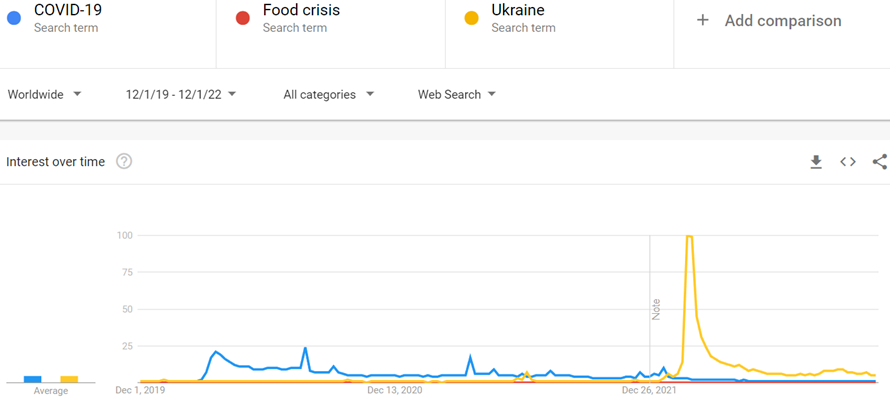
Source: Google Trends.
Both the MDGs and the SDGs are proposals directed at states, and the United Nations has not prepared a participation guide for the general public. This has been a shortcoming, but it also provides a point of focus for future action. Zero Hunger is an undertaking that benefits all humanity, and it must therefore also be a global effort that does not ignore the power of ordinary citizens. Members of the public can choose environmentally friendly forms of transport, thereby slowing the deterioration of agricultural conditions caused by climate change. They can also place coins in donation boxes to provide funds for Zero Hunger. Or they can tell others about the state of hunger in the world, further drawing out potential that has previously gone unnoticed. What matters is how to encourage people to make that choice.
We do not have the power to interfere with others, but through appeals to governments, media reporting, and school education, we can create a more inclusive social environment and increase public participation in achieving Zero Hunger. In other words, it is necessary to examine each form of power that can contribute to Zero Hunger and draw out the potential for growth behind it. If universities increase the number of students who aspire to work in agriculture, those students may contribute to agricultural development after graduation. If children learn from an early age in the classroom that many people around the world suffer from hunger, they may reduce food waste. Global transformation becomes possible only when goals, society, and states are connected and act in solidarity.
Conclusion
Eradicating hunger is a difficult and complex undertaking, and no single approach can open a perfect path. Yet this is precisely what gives meaning to action aimed at achieving Zero Hunger.
The destruction of food security caused by war and disease outbreaks is alarming, but the humanitarian understanding that supports the Black Sea Grain Initiative and the record of private companies contributing to WFP can give us strength. The failure to achieve the MDGs sowed the seeds of the present adverse conditions, while an adequate right to food and the future transformation of food systems have given us an opportunity to make up for those shortcomings. Through failure, we can reflect more deeply on our problems and gain new momentum from the lessons learned.
This paper aims to offer ideas for working towards Zero Hunger. When short-term problems are alleviated and long-term measures are improved, humanity can move closer to a world without hunger.
References
FAO, IFAD, UNICEF, WFP and WHO. 2022. The State of Food Security and Nutrition in the World 2022: Repurposing Food and Agricultural Policies to Make Healthy Diets More Affordable. Rome: FAO. https://doi.org/10.4060/cc0639en. Accessed 30 Jan. 2023.↩︎
Bruce Edwards, “A looming food crisis,” Finance and Development, IMF. https://www.imf.org/en/Publications/fandd/issues/2022/09/Cafe-Econ-a-looming-Food-Crisis. Accessed 30 Jan. 2023.↩︎
“First batch of Russian fertiliser exported under a United Nations agreement to be shipped to Malawi next week,” UN News. https://news.un.org/zh/story/2022/11/1112347. Accessed 30 Jan. 2023.↩︎
Black Sea Grain Initiative Vessel Movements, HDX. https://data.humdata.org/dataset/black-sea-grain-initiative-vessel-movements. Accessed 30 Jan. 2023.↩︎
FAO Food Price Index, FAO. https://www.fao.org/worldfoodsituation/foodpricesindex/en/. Accessed 30 Jan. 2023.↩︎
António Guterres, “We need to act now to avoid the worst impacts of our efforts to control the pandemic,” launch of policy brief on food security, UN. https://www.un.org/en/coronavirus/we-need-act-now-avoid-worst-impacts-our-efforts-control-pandemic. Accessed 30 Jan. 2023.↩︎
“WTO members secure unprecedented package of trade outcomes at MC12,” WTO. https://www.wto.org/english/news_e/news22_e/mc12_17jun22_e.htm. Accessed 30 Jan. 2023.↩︎
Contributions to WFP in 2022, WFP. https://www.wfp.org/funding/2022. Accessed 30 Jan. 2023.↩︎
WFP/EB.2/2020/5-A/1/Rev.1.↩︎
“We are completely reliant on voluntary donations,” WFP. https://www.wfp.org/who-we-are?_ga=2.101118786.2112489116.1674576474-2135169246.1670603348. Accessed 30 Jan. 2023.↩︎
WFP/EB.2/2021/4-A/1.↩︎
Donation amounts reported by three organisations: 7-Eleven, https://www.7midori.org/bokin/bokinsuii/; FamilyMart, https://www.family.co.jp/sustainability/material_issues/society/ngo_npo/dbf_bokin.html; Lawson, https://www.lawson.co.jp/company/activity/topics/detail_jin/1457719_9112.html. Accessed 30 Jan. 2023.↩︎
“Understanding the dynamics of food insecurity and vulnerability in Orissa, India,” ESA Working Papers 07-28, Food Security and Agricultural Projects Analysis Service (ESAF), 2007. https://www.fao.org/agrifood-economics/publications/detail/en/c/120817/. Accessed 30 Jan. 2023.↩︎
The Right to Adequate Food, OHCHR Fact Sheet No. 34, OHCHR/FAO. https://www.ohchr.org/en/publications/fact-sheets/fact-sheet-no-34-right-adequate-food. Accessed 30 Jan. 2023.↩︎
Dr Agnes Kalibata, United Nations Secretary-General’s Special Envoy to the 2021 Food Systems Summit, “The Food Systems Summit - A New Deal for People, Planet and Prosperity,” New York. https://www.un.org/en/food-systems-summit/news/food-systems-summit-new-deal-people-planet-and-prosperity. Accessed 30 Jan. 2023.↩︎
António Guterres, United Nations Secretary-General’s remarks at the Food Systems Summit, New York. https://www.un.org/en/food-systems-summit/news/un-secretary-generals-remarks-food-systems-summit. Accessed 30 Jan. 2023.↩︎
Jean-Jacques Rousseau, Discourse on the Origin of Inequality, Simplified Chinese edition, translated by Deng Bingyan, Zhejiang Publishing United Group.↩︎